

Braided cables may offer the superior durability in many applications as they can withstand bending, vibration, movement and mechanical stress more effectively than rigid conductors. A braided cable, however, is not necessarily going to last longer just by virtue of its braided construction.
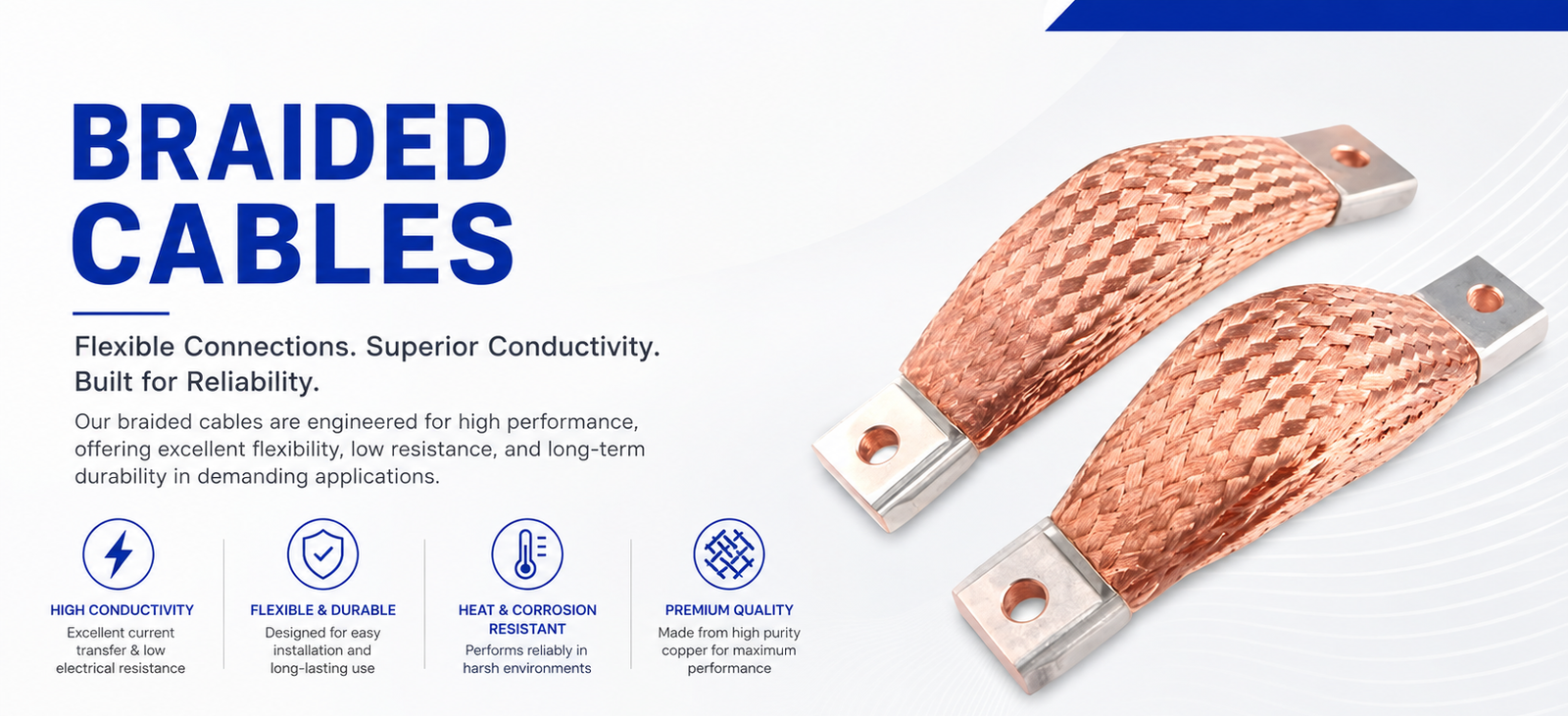
This actual lifetime is influenced by the conductor material, the structure of the braid, the insulation, the temperature, the current load, the installation process, the environment, and the frequency of movement.
What Is a Braided Cables?
A braided cable consists of several strands of conductive material woven together in a braided pattern.
The conductor may utilize, depending on the application:
The use of braided constructions in electrical cable, electrical grounding strap, electrical bonding, flexible jumper and electrical component.
The principal benefit of the braided construction is that each strand is allowed to move with respect to the other, making the finished conductor flexible.
| Specification | Details |
|---|---|
| Material | Copper / Tinned Copper |
| Construction | Multiple fine wires braided together |
| Flexibility | Excellent |
| Conductivity | High |
| Wire Diameter | Customizable |
| Application | Grounding, bonding, battery connections, switchgear & transformers |
Do Braided Copper Cables Resist Vibration?
In many cases, yes. Braided copper wires are especially useful when the electrical connection is subjected to vibration or movement.
Common applications include:
Motors
Mechanical vibration is a byproduct of the operation of motors. Flexible connections can be used to accommodate this movement.
Transformers
Vibration and thermal expansion can occur in transformers.
Generators
Mechanical movement may necessitate flexible electrical and grounding connections with generators.
Switchgear
There are components in switchgear assemblies that may need flexible electrical connections.
Industrial Machinery
Mechanical vibration can be quite large in manufacturing and processing equipment.Copper Braided Jumpers and Cable Durability
Copper braided jumpers are a unique kind of adaptable electrical links.
Does Braiding Give Better Electrical Performance?
Braiding is done primarily for flexibility.
This does not necessarily imply that a braided conductor will have less electrical resistance than all of the other conductors.
The following factors affect electrical performance:
A braided copper conductor of the proper size can offer good electrical conductivity and flexibility.
When to use a braided cable?
A braided cable can be a good choice when the connection needs to tolerate:
Repeated bending
Vibration
Mechanical movement
Thermal expansion
Limited installation space
Equipment movement
Flexible bonding or grounding, which permits the use of small wires.
For a completely fixed connection with little movement, a rigid conductor may be more appropriate.
Do Braided Cables Make Sense?
For applications where movement or vibration is required, braided cables can be very useful.
That they are “longer lasting” is not the primary benefit. Their benefit is that they are better built to allow flexibility and mechanical movement.
For instance, a flexible copper braided jumper can be used to allow for movement and vibration in equipment rather than using a rigid connection.
In fixed installations, however, the added flexibility of the braided cable may not be of significance.