

A flexible electrical conductor composed of a number of copper strands of fine gauge covered with a very thin layer of tin and braided together. It combines the excellent electrical properties of copper, with the added protection to the environment that tin provides.
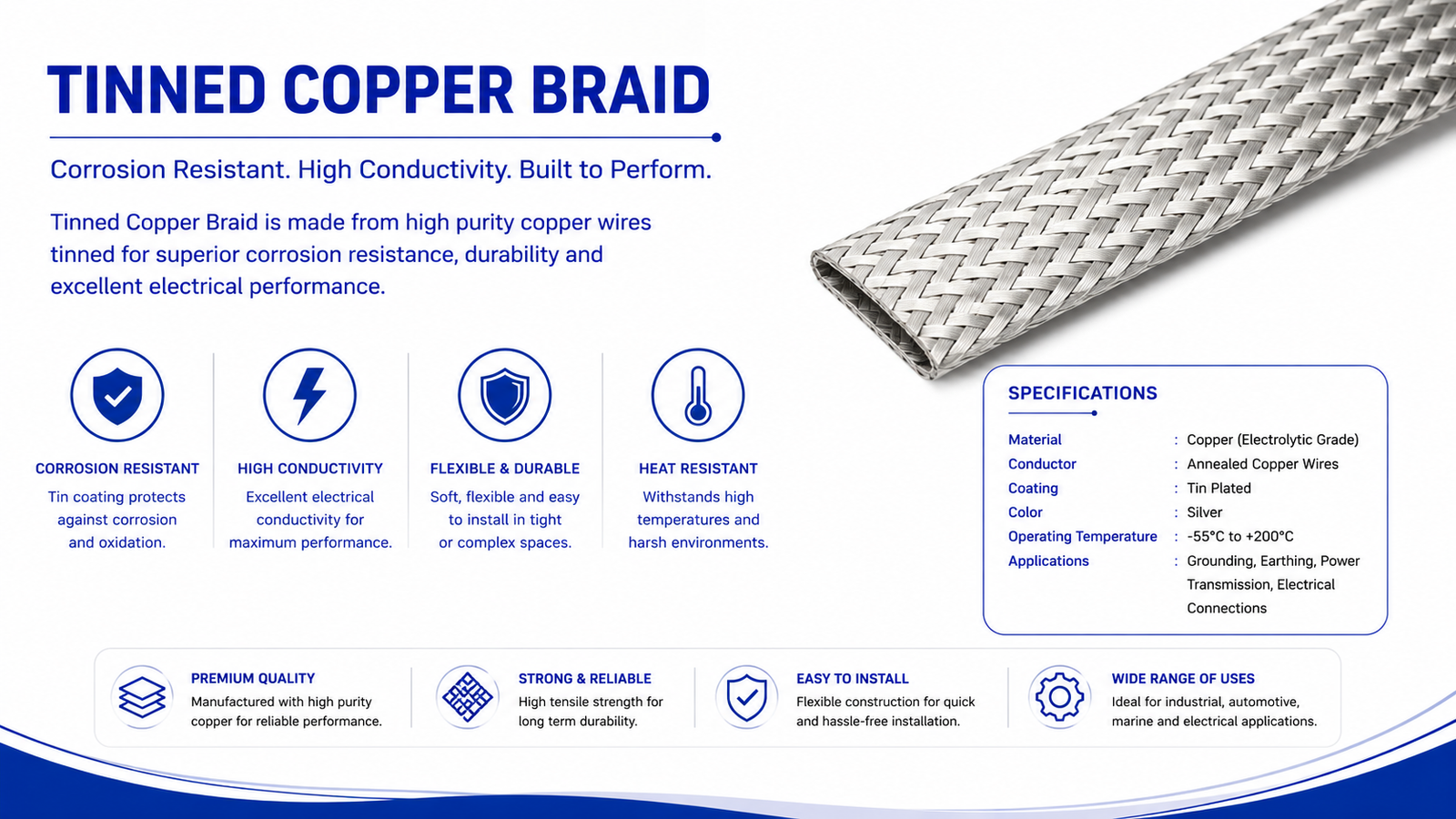
Tinned copper braid is used in grounding, bonding, electrical connections, battery systems, automotive equipment, switchgear, control panels and industrial applications, due to its flexibility, conductivity, resistance to oxidation and corrosion.
A braided copper connection is flexible and will move, vibrate, and withstand repeated flexing unlike rigid copper bars or solid conductors, and is ideal where a flexible electrical connection is needed.
What Is Tinned Copper Braid?
Tinned copper braid is a flexible braid made from fine wires of copper which have been coated with tin.
The copper is the principal source of electrical conductivity and the tin layer can be used to protect the copper from environmental exposure.
Copper braid tinned can be produced in various:
It can be provided as a flat braid, tubular braid or as a fabricated flexible jumper with terminals, based on design.
| Specification | Details |
|---|---|
| Material | High-Conductivity Copper |
| Coating | Tin-Plated |
| Wire Diameter | 0.10–0.30 mm |
| Width | 5–200 mm |
| Thickness | 0.5–10 mm |
Why Is Copper Tinned?
When copper is left in air and water, it will naturally get covered with a thin oxide film. Copper is still a good conductor but, in some conditions, surface oxidation may be a factor.
Tinning is an added layer of protection on top of the copper strands. This can increase the corrosion resistance and oxidation resistance and can also make the conductor easier to solder.
This is one of the primary factors that makes tinned copper braid the material of choice for challenging electrical applications.
Key Benefits of Tinned Copper Braid
Excellent Electrical Conductivity
Copper has a high electrical conductivity as is well known. Tinned copper braid has the same conductive characteristics as the copper strands, and offers a protective surface coating.
Hence it is suitable for electrical grounding, bonding, power connections and other applications that require an effective conductive path.
Improved Corrosion Resistance
Some of the greatest benefits of tinned copper braid is that it provides enhanced protection against corrosion than exposed copper.
The tin coating helps protect the copper strands from environmental conditions such as humidity and moisture.
Therefore, tinned copper braid can be used in:
High Flexibility
The braid is not a single conductor but is made up of numerous strands.
This type of construction can be flexed and bent easily, useful for connections between moving or vibrating parts.
Tinned copper braid is commonly employed as a flexible grounding/bonding.
It is able to electrically connect:
Tinned Copper Braid Uses
Tinned copper braid is used in a number of industries for its conductivity and flexibility.
Electrical Grounding:
Tinned copper braid is used for many purposes, one of which is grounding.
A flexible braid may be used to connect equipment to a grounding point, or to move components around, and to keep the low-impedance connection.
Electrical Bonding
Tinned copper braid can be used to electrically bond separate metal components.
For instance, it can be mounted between a cabinet door and enclosure, ensuring electrical continuity as the door is opened and closed.
Switchgear and Electric Panels
Electrical panels and switchgear frequently have parts that need to be flexibly connected.
Tinned copper braid can be used to:
Many of the electrical components of an automotive system are subjected to vibration and changes in temperature.
Tinned copper braid can be used to:
Frequently Asked Questions
What is tinned copper braid used for?
Tinned copper braid is commonly used for grounding, bonding, flexible electrical connections, battery connections, switchgear, control panels, machinery, automotive systems, and EMI shielding applications
Can tinned copper braid be used for grounding?
Yes. Tinned copper braid is widely used for flexible grounding and bonding applications.