

Insulated Copper Busbar Electronic Conductors are conductors of copper with insulating material. Their purpose is to carry and transport electricity as well as provide an electrical separation between the electricity and surrounding parts.
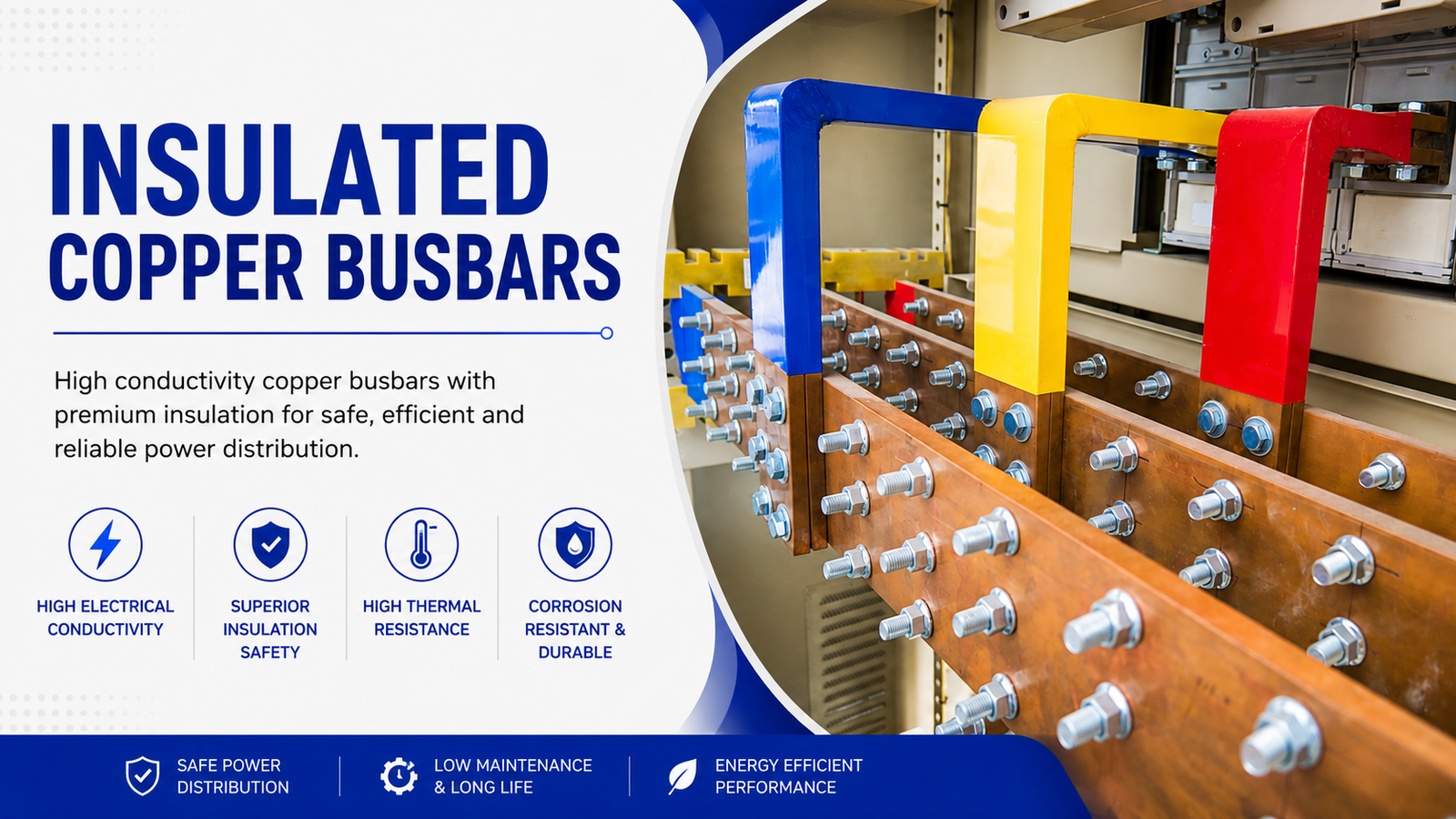
Insulated copper busbars provide extra protection from accidental contact, short circuits, contamination and electrical clearance issues as compared to conventional bare copper busbars.
They have extensive applications in electrical panels, switchgear, power distribution systems, distribution boards, battery applications, power supplies, EV equipment, solar inverters, UPS and industrial power-distribution applications.
What Are Insulated Copper Busbars?
An insulated copper busbar is a copper conductive core covered with an electrically insulating layer.
The copper offers an easy flow path for the current and the insulation electrically isolates the conductor from the other conductive elements.
The copper core can be:
Insulation may be applied as a continuous coating, sleeve, heat shrink material or any other appropriate insulating system.
Type of insulation and thickness will vary depending on the voltage, temperature, environment, flexibility and application
| Specification | Details |
|---|---|
| Material | High-Conductivity Copper |
| Copper Grade | ETP / EC Grade |
| Insulation | PVC / Heat-Shrink / Epoxy / Polyolefin |
| Construction | Solid / Laminated Copper Bar |
| Surface Finish | Bare / Tin-Plated Copper |
| Insulation Voltage | Application dependent |
| Thickness | Customizable |
Why Are Copper Busbars Insulated ?
Bare copper would be a good conductor but can cause issues if it comes into contact with other conductors.
Insulation can help:
But this does not mean that insulation is a cure-all for electrical design, spacing, protection, and installation practices.
Types of Insulation Used on Copper Busbars
Depending on the application, different insulation systems are possible.
Heat-Shrink Insulation:
A heat-shrink material can be used to encircle a copper busbar to ensure electrical insulation and extra protection.
PVC Insulation:
Depending on the required temperature and electrical properties, PVC can be used for suitable applications with low and medium voltage levels.
Epoxy Coating:
On some busbar designs, epoxy can be used to keep the busbar protected.
Polyester Insulation:
Polyester films and other products may be used in laminated and insulated busbar structures.
Polyolefin Insulation:
For those applications where suitable, materials for electrical insulation are made from polyolefin.
The selection of the insulation shall be always dependent on the following requirements: voltage, temperature, flexibility, environment exposure and standards.