

As more solar, wind, battery storage and other renewable energy sources are adopted, there is a growing need for dependable and efficient electrical connections. Due to the combination of its excellent electrical conductivity, flexibility and compact installation, copper flexible busbars are now widely adopted in renewable energy equipment.
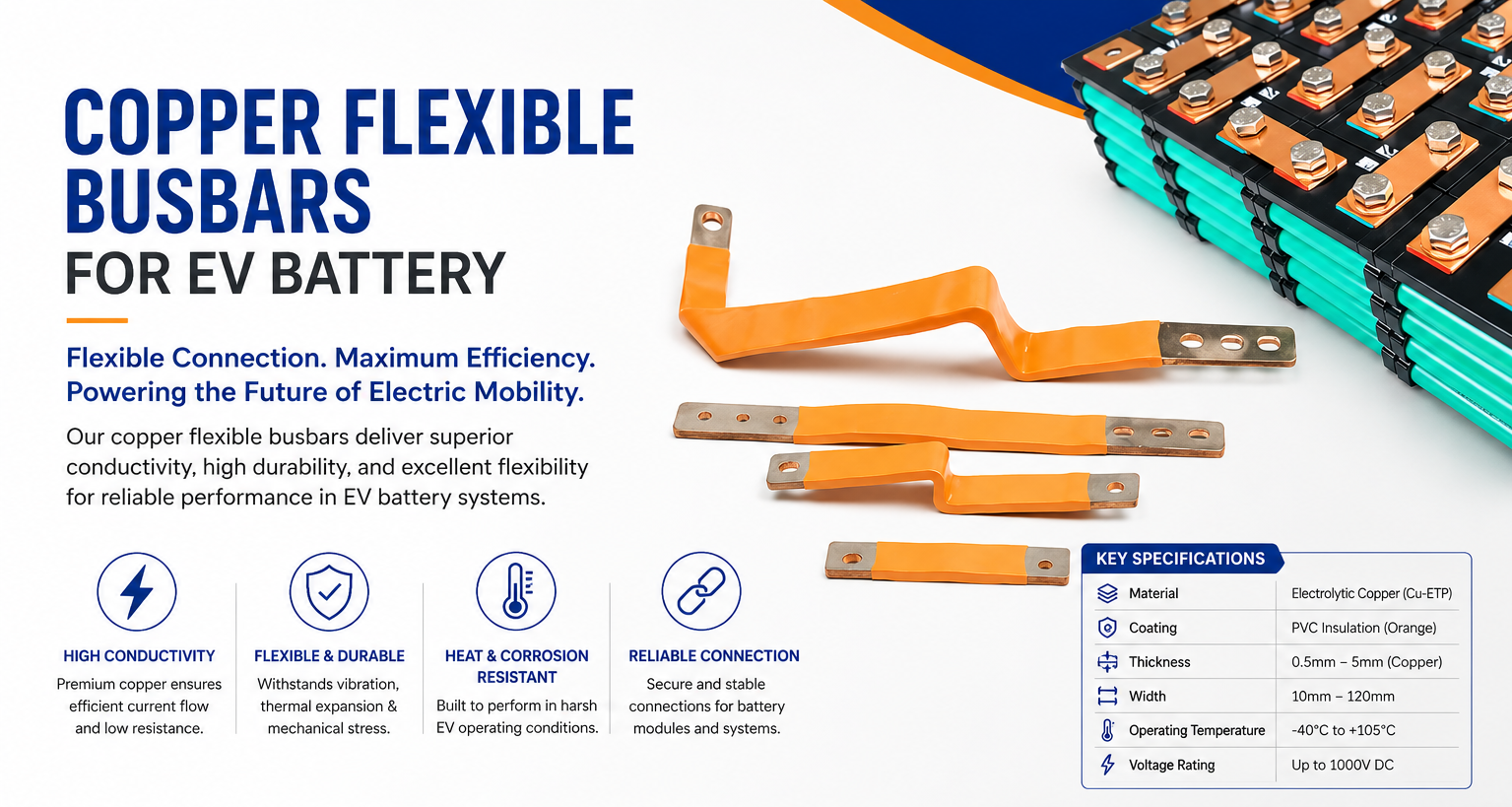
Flexible copper busbars offer the added benefits of allowing for movement and vibration, thermal expansion, and installation restrictions, which are impossible with a conventional rigid copper bar. This renders their application in solar power systems, battery energy storage systems, inverters, power distribution systems and other renewable energy applications.
For renewable energy, copper busbars can help facilitate efficient electrical connections between the key components in a system as renewable energy installations become smaller, more compact and more power-dense.
Why Are Copper Flexible Busbars Used in Renewable Energy Systems?
Renewable energy equipment frequently deals with high electrical currents and demands compact and flexible electrical connections. A copper flexible busbar is a great alternative for solar power systems, battery energy storage systems, wind-energy equipment, inverters and power distribution assemblies.
| Specification | Details |
|---|---|
| Material | High-Conductivity Copper |
| Copper Grade | ETP / EC Grade |
| Thickness | 0.2–10 mm |
| Width | 10–200 mm |
| Length | Customizable |
The flexibility and conductivity of a copper flexible busbars ensures it will withstand movement, vibration, thermal expansion and limited installation space, while providing an efficient electrical connection.
1. Excellent Electrical Conductivity:
Copper flexible busbars is excellent for electrical conduction, adapt to renewable energy equipment to carry high current.
Copper has a low electrical resistance that will provide an efficient current path between components. The necessary electrical requirements, temperature, installation conditions, and current are always considered when selecting the correct size of copper flexible busbar.
2.High Flexibility:
The foremost benefit of a copper flexible busbar is that it can be bent and flexed.
A copper flexible busbars can be routed around components, installed where connection points are not perfectly aligned, unlike a rigid copper bar.
Inside a flexible copper busbar can be helpful:
3.Accommodates Thermal Expansion:
Renewable energy equipment can experience considerable temperature variations during operation.
For instance, solar power equipment can get hot when there is a lot of solar power generation, and cold when the system isn’t producing.
It allows a little flexibility of the copper flexible busbars due to thermal expansion and contraction. This flexibility can help to minimize mechanical stress at connection points.
4.Vibration Resistance:
Mechanical vibration can occur in wind turbines, battery systems and other renewable energy equipment.
A copper flexible busbars has the ability to cope with some movement and vibration better than a rigid conductor.
This renders the copper flexible busbars especially advantageous in situations where electrical connections require not only electrical conductivity but also mechanical flexibility.
Frequently Asked Questions
Yes. They can be used for suitable high-current connections between battery modules, power distribution components, contactors, and other electrical equipment.
Neither is universally better. Flexible busbars are advantageous where movement, vibration, thermal expansion, or compact routing is important. Rigid busbars can be ideal for fixed electrical connections.