

Properly selecting the right size of copper flexible busbar is crucial to ensure reliable electrical performance, heat management, and mechanical connection. The size required will vary according to a number of factors such as width, thickness, cross-sectional area, current, operating temperature, installation conditions and flexibility requirements.
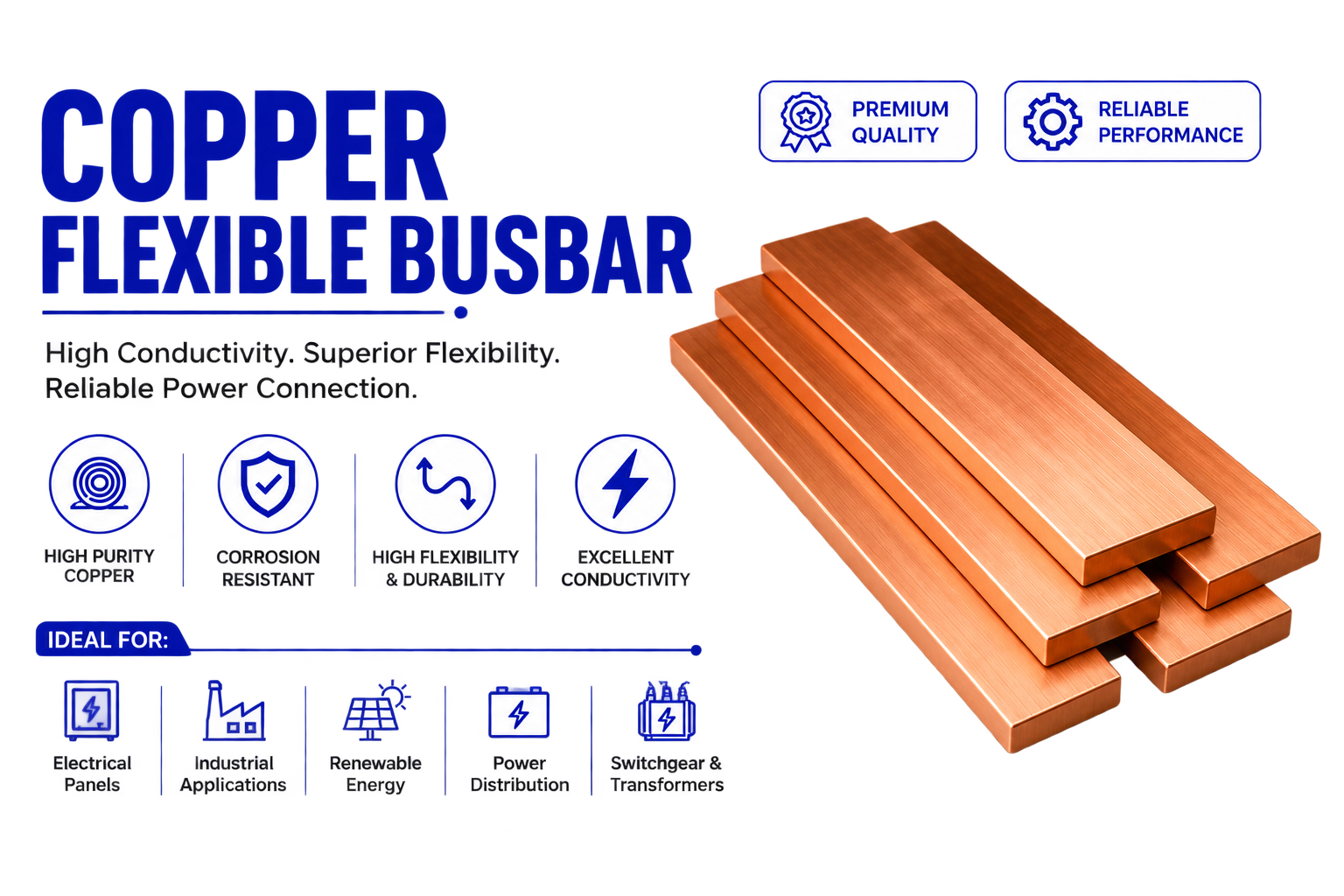
The copper flexible busbar is designed to be able to conduct, but it can be more flexible than a rigid copper busbar. Can be applied to switchgear, transformers, electrical panels, battery systems, renewable energy equipment, EV systems and power distribution assemblies.
What Is a Copper Flexible Busbar?
A flexible busbar made of copper, also known as a copper flexible busbar, is a type of flexible electrical conductor produced from multiple copper layers, fine copper wires or braided copper.
When compared to stiff copper busbar, a copper flexible busbar is capable of bending and will allow some movement, vibrations and thermal expansion.
Depending on the design, flexible busbars can be provided with:
Always the appropriate copper flexible busbar size should be based on the actual electrical and mechanical specifications of the application.
Copper Flexible Busbar Size Chart
| A | Part Code | N × A × B (mm) | Cross Section (sqmm) | ΔT 70K (A) | ΔT 60K (A) | ΔT 50K (A) | ΔT 40K (A) | ΔT 30K (A) | Current Coefficient | Length 2M / Pack Qty |
|---|---|---|---|---|---|---|---|---|---|---|
| 125A | 1258605 | 8 × 6 × 0.5 | 24.00 | 196 | 182 | 166 | 143 | 128 | 1.72 / 2.25 | 10 |
| 1253908 | 3 × 9 × 0.8 | 21.60 | 158 | 147 | 134 | 120 | 104 | 1.72 / 2.25 | 10 | |
| 1253135 | 3 × 13 × 0.5 | 19.50 | 198 | 184 | 167 | 150 | 130 | 1.72 / 2.25 | 10 | |
| 1252158 | 2 × 15.5 × 0.8 | 25.80 | 252 | 234 | 212 | 191 | 165 | 1.72 / 2.25 | 10 | |
| 250A | 2504158 | 4 × 15.5 × 0.8 | 49.60 | 380 | 350 | 320 | 286 | 248 | 1.72 / 2.25 | 5 |
| 2502021 | 2 × 20 × 1 | 40.00 | 326 | 300 | 275 | 246 | 214 | 1.72 / 2.25 | 5 | |
| 2503201 | 3 × 20 × 1 | 60.00 | 428 | 395 | 360 | 323 | 280 | 1.72 / 2.25 | 5 | |
| 2502241 | 2 × 24 × 1 | 48.00 | 450 | 416 | 380 | 340 | 295 | 1.72 / 2.25 | 5 | |
| 2506135 | 6 × 13 × 0.5 | 39.00 | 300 | 277 | 253 | 226 | 196 | 1.72 / 2.25 | 5 | |
| 400A | 4005201 | 5 × 20 × 1 | 100.00 | 498 | 460 | 420 | 376 | 326 | 1.72 / 2.25 | 5 |
| 4003241 | 3 × 24 × 1 | 72.00 | 490 | 453 | 413 | 370 | 320 | 1.72 / 2.25 | 5 | |
| 4004241 | 4 × 24 × 1 | 96.00 | 550 | 510 | 465 | 416 | 360 | 1.72 / 2.25 | 5 | |
| 4002321 | 2 × 32 × 1 | 64.00 | 480 | 445 | 406 | 363 | 315 | 1.72 / 2.25 | 5 | |
| 4002401 | 2 × 40 × 1 | 80.00 | 538 | 500 | 455 | 406 | 352 | 1.72 / 2.25 | 5 | |
| 4006158 | 6 × 15.5 × 0.8 | 74.40 | 476 | 440 | 402 | 360 | 318 | 1.72 / 2.25 | 5 | |
| 500A | 5005241 | 5 × 24 × 1 | 120.00 | 608 | 563 | 514 | 460 | 398 | 1.72 / 2.25 | 5 |
| 5004321 | 4 × 32 × 1 | 128.00 | 648 | 600 | 548 | 490 | 425 | 1.72 / 2.25 | 5 | |
| 630A | 6308241 | 8 × 24 × 1 | 192.00 | 802 | 743 | 678 | 606 | 525 | 1.72 / 2.25 | 5 |
| 6305321 | 5 × 32 × 1 | 160.00 | 758 | 702 | 640 | 573 | 496 | 1.72 / 2.25 | 5 | |
| 6306321 | 6 × 32 × 1 | 192.00 | 846 | 783 | 715 | 640 | 555 | 1.72 / 2.25 | 5 | |
| 6305401 | 5 × 40 × 1 | 200.00 | 900 | 832 | 760 | 680 | 590 | 1.72 / 2.25 | 5 | |
| 6301201 | 10 × 20 × 1 | 200.00 | 762 | 706 | 645 | 576 | 500 | 1.72 / 2.25 | 5 | |
| 800A | 8000241 | 10 × 24 × 1 | 240.00 | 948 | 877 | 800 | 716 | 592 | 1.72 / 2.25 | 5 |
| 8008321 | 8 × 32 × 1 | 256.00 | 1018 | 943 | 860 | 770 | 667 | 1.72 / 2.25 | 5 | |
| 8006401 | 6 × 40 × 1 | 240.00 | 1018 | 943 | 860 | 770 | 667 | 1.72 / 2.25 | 5 | |
| 8005501 | 5 × 50 × 1 | 250.00 | 1100 | 1016 | 930 | 830 | 718 | 1.72 / 2.25 | 5 | |
| 1000A | 1008401 | 8 × 40 × 1 | 320.00 | 1230 | 1140 | 1040 | 930 | 805 | 1.72 / 2.25 | 3 |
| 1008501 | 8 × 50 × 1 | 400.00 | 1393 | 1290 | 1175 | 1050 | 912 | 1.72 / 2.25 | 3 | |
| 1250A | 1251501 | 10 × 50 × 1 | 500.00 | 1650 | 1525 | 1395 | 1245 | 1080 | 1.72 / 2.25 | 2 |
Frequently Asked Questions
Yes. Increasing conductive thickness increases cross-sectional area and can increase current capacity, but it may also affect flexibility and thermal performance.