

A copper flexible busbar is an electrical conductor designed to carry current while providing greater mechanical flexibility than a conventional rigid busbar. Copper flexible busbars are commonly used where electrical components need to be connected across limited spaces, vibration-prone areas, or locations where thermal expansion and mechanical movement need to be accommodated.
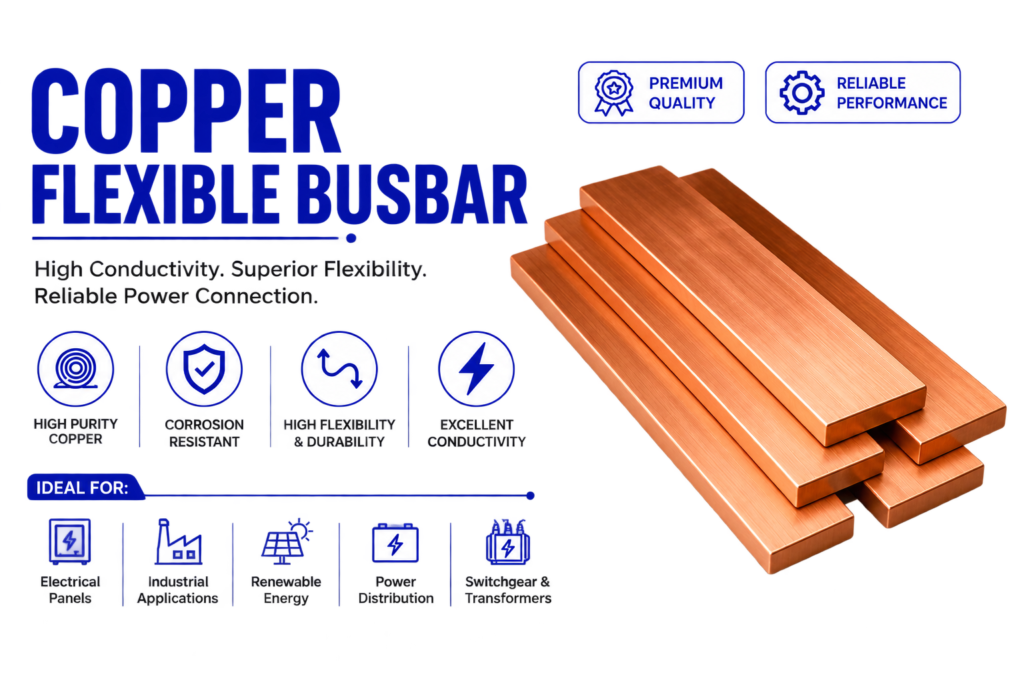
Copper flexible busbars are used in a wide range of electrical and industrial applications, including switchgear, electrical panels, transformers, battery systems, UPS equipment, power distribution systems, motors, generators, renewable energy equipment, EV systems, and industrial machinery.
What Is a Copper Flexible Busbar?
A copper flexible busbar is a current-carrying conductor that can bend or flex to accommodate the physical arrangement of electrical equipment.
Unlike rigid busbars, which are generally manufactured from solid copper or aluminium bars, copper flexible busbars use constructions that provide greater mechanical flexibility.
Common flexible busbar constructions include:
Copper busbars are particularly useful when electrical components cannot be connected easily using a rigid conductor.
What Are the Main Applications of Copper Flexible Busbars?
Copper busbars are used in electrical systems where a combination of high current capacity, flexibility, compact installation, and mechanical movement tolerance is required.
The major applications include:
| Specification | Copper Flexible Jumpers / Flexible Busbars |
|---|---|
| Material | High-Conductivity Copper |
| Copper Grade | ETP / EC Grade |
| Length | As per requirement |
| Width | 10–200 mm (customizable) |
| Thickness | 0.2–10 mm (customizable) |
| Application | Switchgear, Transformers, Panels, Batteries & Power Systems |
1. Copper Flexible Busbar Applications in Switchgear
Switchgear is one of the most common applications for copper flexible busbars.
Switchgear assemblies contain circuit breakers, switches, terminals, busbars, and other components that often need to be connected within a restricted enclosure.
A copper flexible busbar can simplify connections between components where a rigid busbar would require complex forming or precise alignment.
2. Electrical Distribution Panels
Copper flexible busbars are commonly employed in electrical distribution and control panels, which simplify the wiring process, making it more efficient, safe, and easy to manage. In a panel, often there are a lot of electrical components in just one small place. Such is the close space that it is much easier to connect various portions using a flexible conductor, than complicated bends or shaping of a rigid busbar.
3. Transformer Connections
Transformers can vibrate and thermally expand while running.
Copper flexible busbars can be used to make electrical connections between transformers and other equipment and to allow a certain amount of movement.
When selecting the proper copper flexible busbar, the required current, size, temperature, flexibility and connection scheme should be taken into consideration.
4. Energy Storage and Battery Systems.
Compact electrical connections with the ability to carry a significant current are needed for battery systems.
Copper flexible busbars are employed in battery and energy storage applications due to their ability to fit inside of reduced space and their capability to endure some mechanical movements.
Copper flexible busbars can be used to connect battery terminals to busbars, inverters, converters or other electrical components.
5. UPS Systems
Reliable electrical connections are needed between the batteries, power converter and distribution equipment in Uninterruptible Power Supply systems.
High current connections within UPS equipment can be made using copper flexible busbars.
Their flexible design helps to ease installation within small UPS cabinets.
6. Motors and Generators
Vibration can be produced by the operation of motors and generators.
Copper flexible busbars can be used to allow for some movement and vibration without breaking the electrical connection.
Applications include: