

The current carrying capacity (also known as ampacity) of the copper braid is the maximum current that can be safely carried by the braid under certain conditions of operation without exceeding an allowable temperature.
Ampacity is not the same for all copper braids. The current carrying capacity is dependent on the construction, length and method of installation of the braid, allowable conductor temperature, ventilation, and connection quality as well as on the cross sectional area of the conductor.
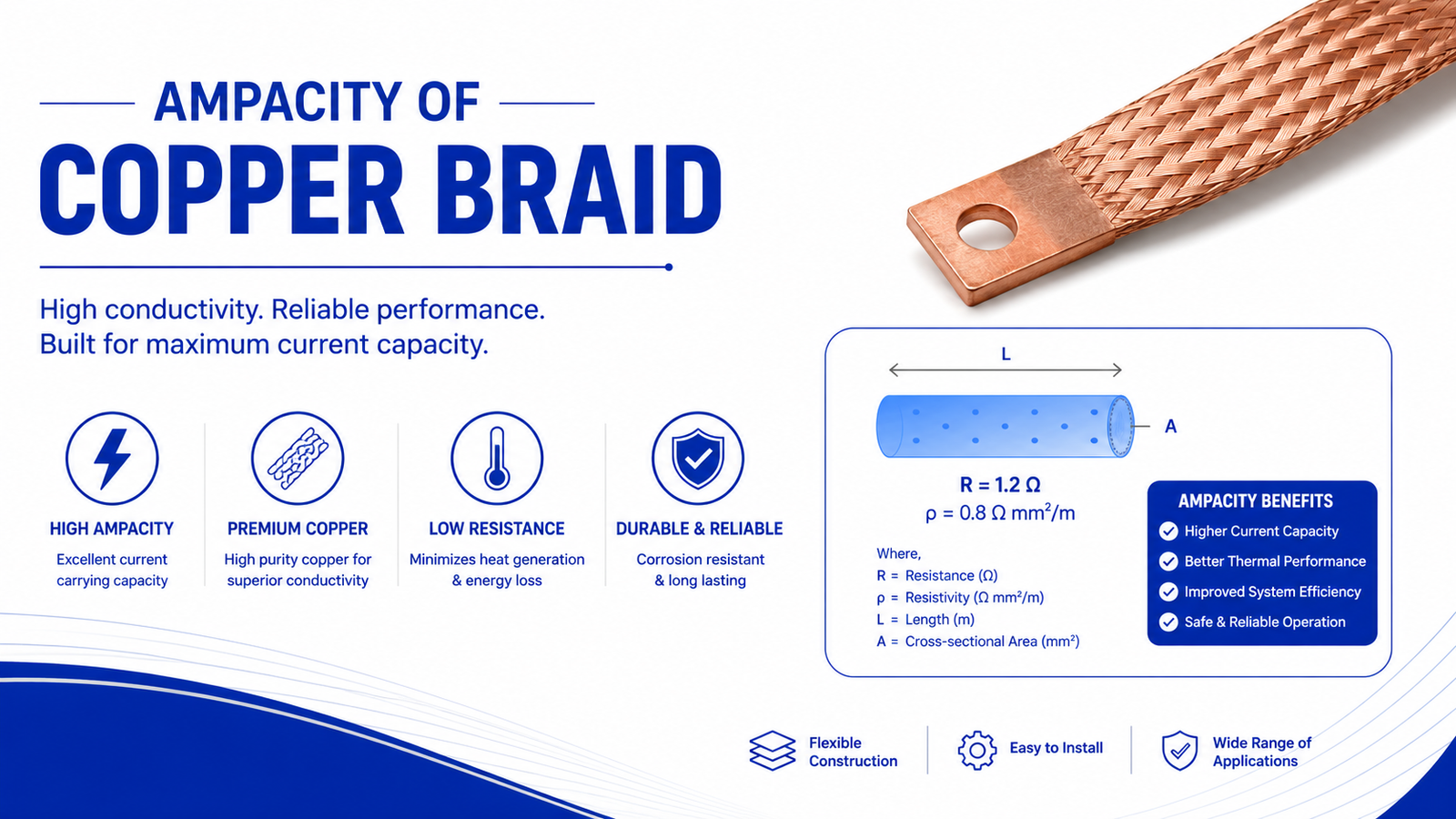
In flexible copper braids, copper braided jumpers and flexible copper busbars, the conductor is used in high current electrical equipment, this is particularly important.
Important: Do not choose a copper braid solely on the width of the braid alone. Always use the current rating of the manufacturer and use the relevant electrical code for the actual application.
How Is Copper Braid Ampacity Determined?
Ampacity is mostly associated with the amount of heat that the conductor produces and the ability of the conductor to dissipate the heat.
Copper braid resistance is dependent on factors, like conductor material, length, and effective cross sectional area. The heat produced by the current, increases with the amount of current, so the braid needs to be of the correct size for the load.
| Specification | Details |
|---|---|
| Material | High-Conductivity Copper |
| Conductor Type | Flexible Braided Copper |
| Ampacity | Depends on cross-section, length & installation |
| Cross-Section | Customizable |
| Wire Diameter | Typically 0.10–0.30 mm |
Factors That Affect Copper Braid Current Capacity
Cross-Sectional Area
The cross sectional area of the copper is one of the most critical items that determines current capacity.
Copper has a lower electrical resistance and can dissipate heat more effectively as the cross section area increases, thus can generally carry more current.
For instance, a small copper braid for bonding should not be automatically assumed to be used for a high current power connection, just because it’s Copper!
Width and thickness of braid.
Copper braids are available in different widths and thicknesses.
The wider or thicker the braid, the more copper it can have and thus the more current it can carry.
But width is not the only factor for determining ampacity.
Two braids of the same width may be rated differently if they have different:
Ambient Temperature
Current capacity is directly affected by the surrounding temperature.
The ability to dissipate heat will generally be better for a copper braid that is operating in an environment with cool temperatures and adequate ventilation, than when the same braid would be installed inside a hot electrical enclosure.
Allowable current may have to be reduced as ambient temperature rises.
Installation Method
The installation of Copper braid also is important.
There is a possibility that a braid installed with good airflow may be able to dissipate heat more effectively than a braid installed in a confined area.
Installation factors can vary and may include:
Copper Braided Jumpers and Ampacity
Copper braided jumpers are frequently used when electrical continuity is required between parts that are subject to movement, vibration or thermal expansion.
Applications include:
The ampacity of a copper braided jumper is dependent on the braid construction and terminal configuration in place.
Copper Braid Ampacity vs Flexible Copper Busbar
Copper braid and flexible copper busbars are both employed to make flexible electrical connections, but they are different in construction.
Flexible copper busbar may be composed of a plurality of copper layers or flexible copper strips, and are generally used for power distribution and high current applications.
The most common uses for copper braid are:
The specific product used is dependent on electrical and mechanical requirement.
Copper Braid for High-Current Applications
Provided it is properly designed and rated, copper braid can be utilized in high current applications.
Engineers may consider for higher current applications:
Selection to be made for continuous current and short circuit conditions if applicable.
Frequently Asked Questions
There is no single ampacity for all copper braids. The allowable current depends on cross-sectional area, braid construction, temperature, installation conditions, and the manufacturer’s rating.
Ampacity should be determined using the manufacturer’s specifications and applicable electrical standards, taking into account conductor size, temperature, installation, and allowable temperature rise.