

Copper busbar insulation is a crucial component of electrical power-distribution systems, contributing to their safety, reliability, and efficiency. The copper core conducts the electrical current; the insulation surrounding the conductor helps to isolate energized surfaces from conductors, equipment and enclosures in the vicinity.
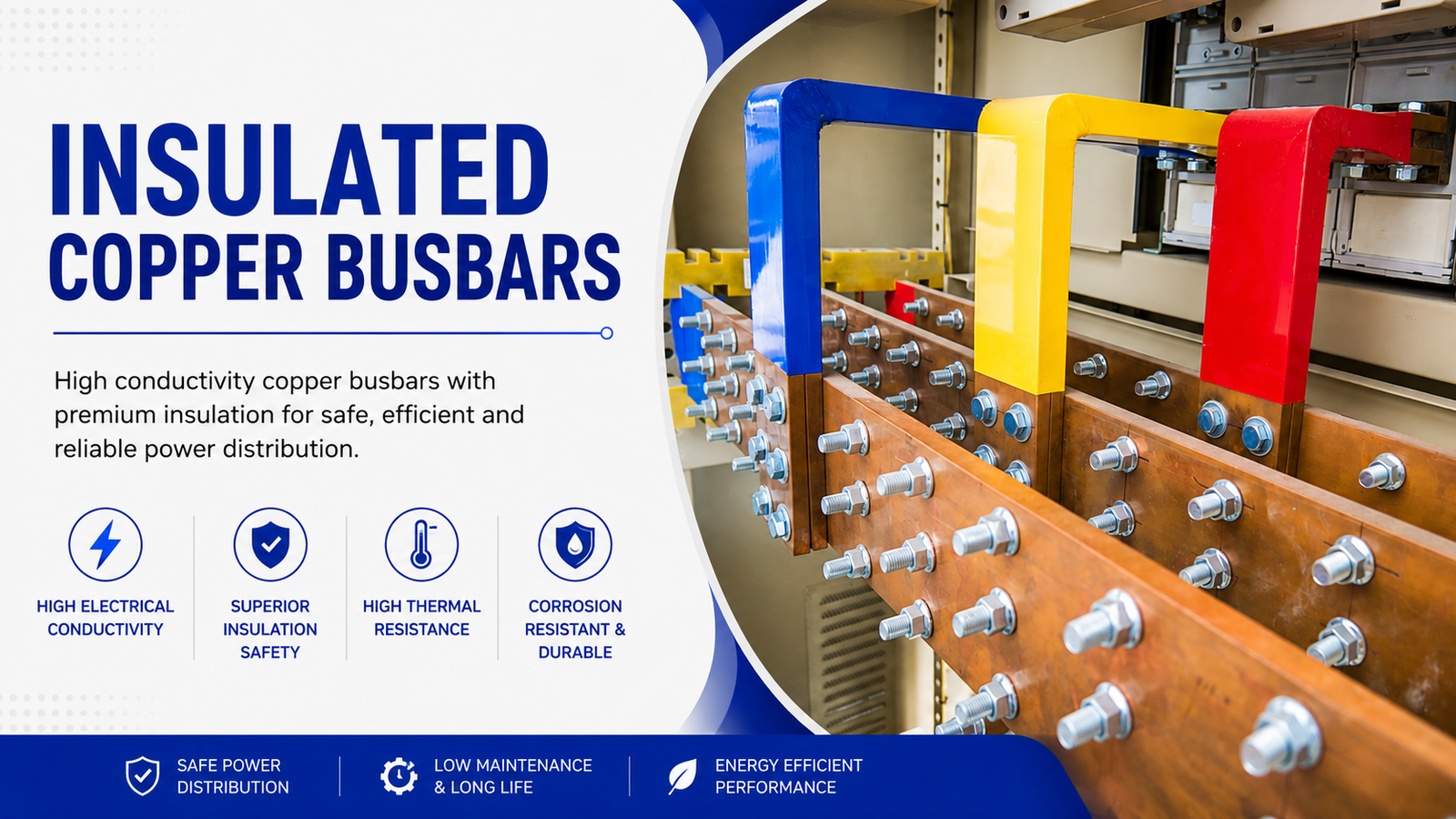
The appropriate selection of insulation can minimise the chance of unintended contact, phase to phase contact, contamination and electrical tracking. But this insulation also impacts heat dissipation, temperature increase, flexibility, space requirements and the overall longevity of a busbar assembly.
Therefore, it is important to understand the effect of insulation on the performance of the copper busbar in the design of electrical panels, switchgear, battery systems, power converters, and other equipments with high current.
What Is Copper Busbar Insulation
Insulation consists of an electrically insulating material which is placed around or over a copper busbar.
The electrical current is carried by the copper and the electrical isolation is provided by the insulation.
Insulation can be achieved by:
The material selected will depend on voltage, temperature, environment, flexibility, mechanical requirements and applicable standards.
| Insulation Type | Typical Characteristics | Suitable Applications |
|---|---|---|
| PVC | Flexible, economical | Electrical panels and general applications |
| Polyolefin | Good electrical insulation and flexibility | Power connections and busbar assemblies |
| Polyester | Good dielectric and mechanical properties | Laminated busbars |
| Epoxy | Durable and rigid | Specialized insulated busbar systems |
| Heat-shrink | Easy installation and protection | Connections and retrofit applications |
| Insulating sleeve | Flexible protection | Busbar and terminal applications |
How to Select the Right Copper Busbar Insulation
When considering copper busbar insulation, keep in mind the following:
Voltage Rating:
Insulation should be appropriate for the operating voltage and the required dielectric properties.
Temperature Rating:
Check the continuous operating temperature and expected temperature rise.
Insulation Thickness:
Choose the correct thickness for electrical/mechanical needs.
Flexibility:
Find out if the busbar must be bent or made to move.
Environment
Consider:
Applications of Insulated Copper Busbars
Insulated copper busbars are commonly used in:
Frequently Asked Questions
No. Insulation does not inherently increase current capacity. In some designs, insulation can reduce heat dissipation, so the thermal performance must be evaluated when determining the allowable current.
Not necessarily. Thicker insulation can improve electrical and mechanical protection but can also increase thermal resistance, dimensions, and rigidity. The thickness should be optimized for the application.