

The vibration, thermal expansion and contraction, movement, and installation misalignment of electrical equipment are normal conditions. Where rigid conductors are employed between components which are in motion with respect to one another, these forces can be transmitted directly to the terminals, bolts, insulators and other electrical equipment.
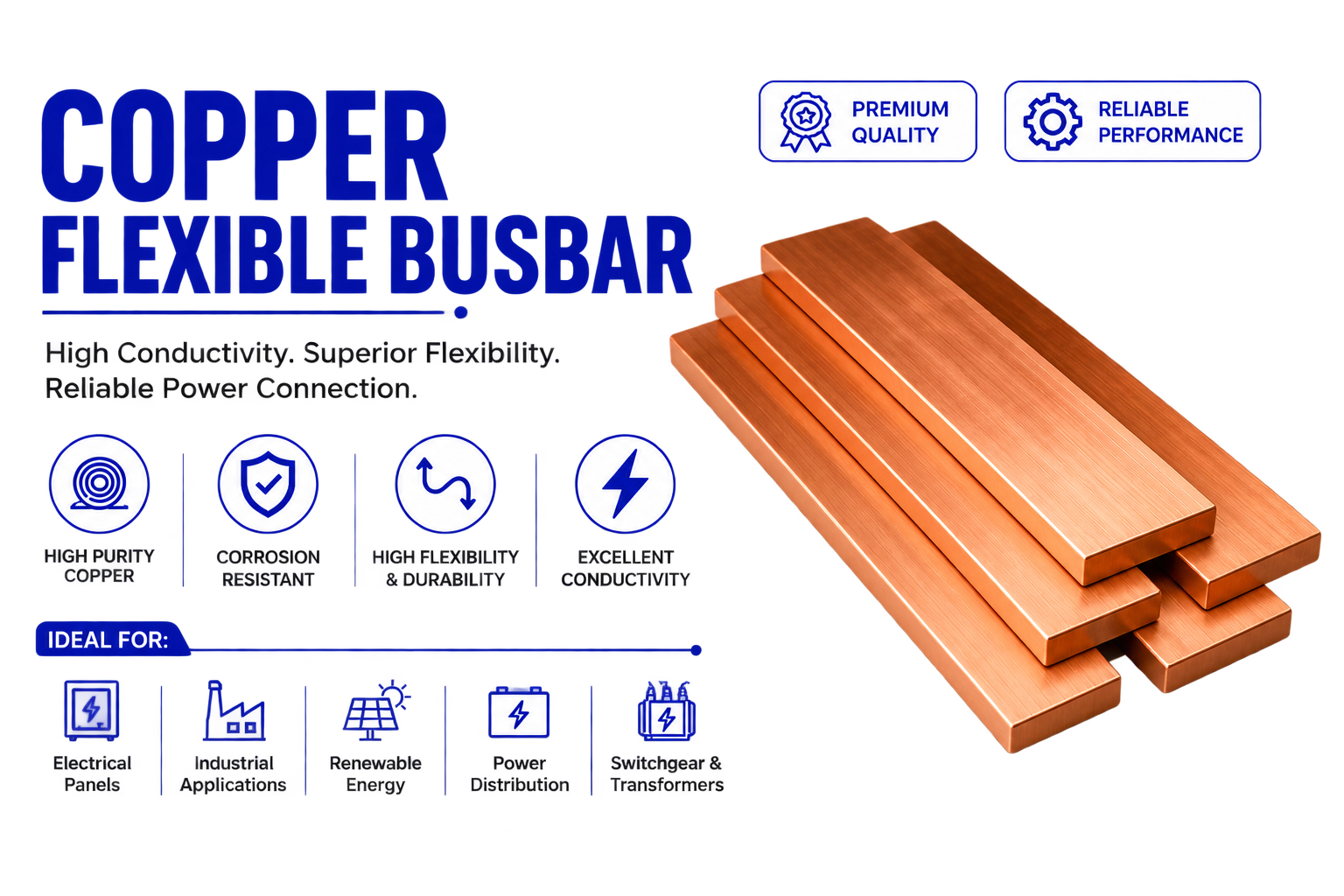
This mechanical stress is mitigated by use of flexible copper bus-bars which allow the electrical connection to flex and move a little.
A flexible copper busbar is also handy in switchgear, transformers, battery systems, EV equipment, solar inverters, power distribution equipment and industrial machinery.
How Do Flexible Copper Busbars Reduce Mechanical Stress?
The basic rule is that:
The force is created when the rigid connection is joined with movement.Force is created when the rigid connection is paired with a motion.
Flexible connection → movement is accommodated by the conductor.
A flexible busbar is the one that can bend or move in a specified range. This can diminish the mechanical force that goes through connection points.
But a flexible busbar cannot take up an infinite amount of motion. The parameters of construction, length, layer number, bend radius, mounting and conditions of operation need to be designed properly.
| Feature | How It Reduces Mechanical Stress |
|---|---|
| High Flexibility | Allows movement between connected electrical components without stressing terminals. |
| Vibration Absorption | Reduces the transfer of vibration from transformers, motors and switchgear. |
| Thermal Expansion | Accommodates expansion and contraction caused by temperature changes |
| Easy Bending | Can be routed around tight spaces without forcing rigid connections. |
| Improved Reliability | Reduces fatigue, cracking and loosening at electrical connections. |
| Longer Service Life | Lower mechanical stress can help extend the life of connected components. |
How Flexible Copper Busbars Are Designed for Mechanical Flexibility
There are a number of design factors which affect the mechanical behaviour of flexible copper busbars.
Number of Copper Layers:
A number of thin layers can offer more flexibility than one thick copper bar.
Length:
A long flexible section will often allow for the more controlled motion than a very short connection.
Thickness:
The thicker a copper section, the higher the current it can withstand, but the less flexible it is.
Width:
The width has an impact on both electrical properties and mechanical properties.
Bend Radius:
To prevent undue mechanical stress or damage, the minimum bend radius must be adhered to.
Terminal Design:
The terminals need to be suitably engineered to resist electrical and mechanical stresses.
Mounting:
The busbar should be supported appropriately but not prevent it from moving as it is supposed to.
Applications of Flexible Copper Busbars
Flexible copper busbars can be used in many applications such as: