

copper flexible jumpers Electrical equipment does not operate without any movement. Mechanical stress may be applied to electrical connections due to vibration, thermal expansion and contraction or small changes in position of the components.
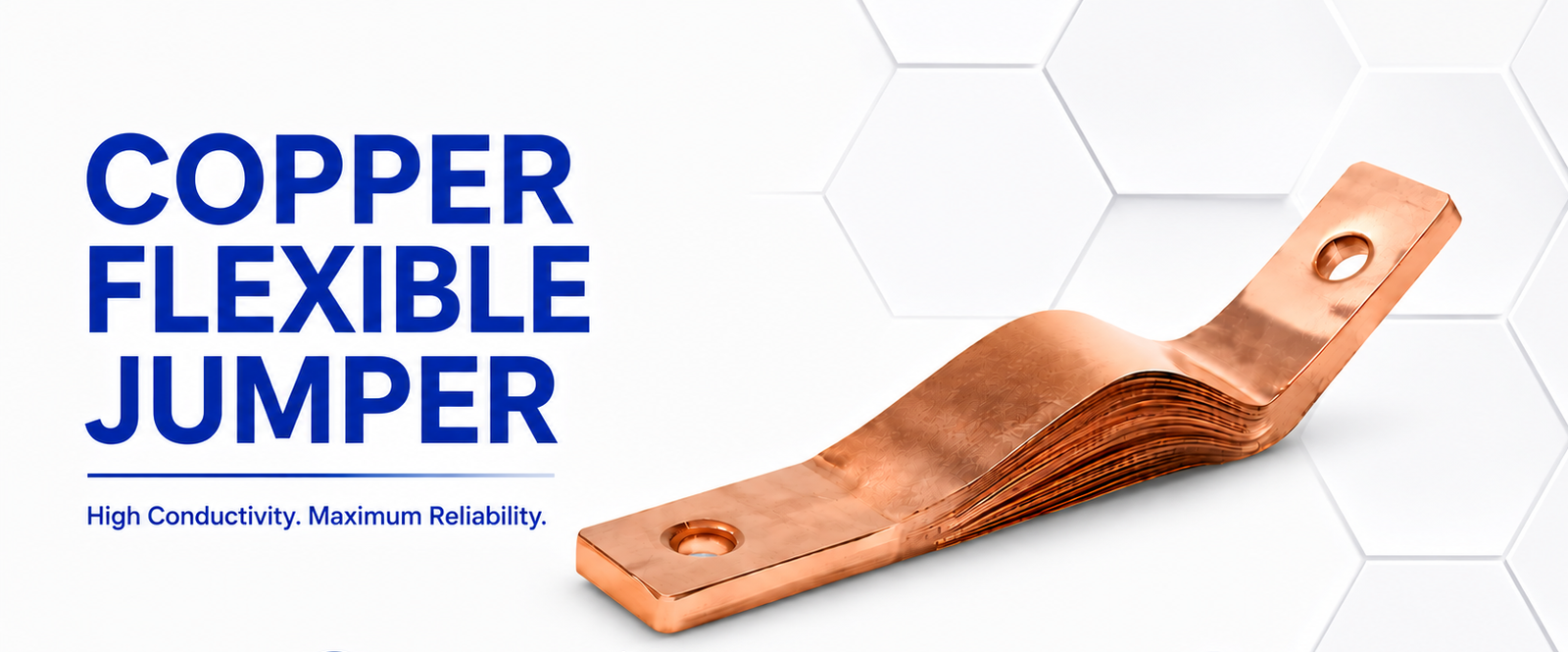
These forces can be passed on to terminals, bolts, insulators and connected equipment via rigid conductors. The copper flexible jumpers enable the electrical connection to remain in good shape even if there is some movement.
Copper flexible jumpers are used in transformers, switchgear, generators, battery systems, EV equipment, solar inverters and industrial electrical assemblies due to its excellent electrical conductivity and flexible constructions that allow for mechanical movement.
How Do Copper Flexible Jumpers Handle Thermal Expansion?
Metals and electric equipment expand and contract in response to temperature change.
This is due to the effects of thermal expansion.
If electrical equipment gets hot:
Component → expands
When it cools down:
Component → contracts
These dimensional changes may result in mechanical forces at the point of connection if two components are connected by a fixed conductor.
A degree of this movement can be accommodated by flexing copper flexible jumpers.
| Feature | Benefit |
|---|---|
| Flexible Construction | Allows movement between electrical components without putting excessive stress on connections. |
| Vibration Resistance | Absorbs mechanical vibration from transformers, motors and switchgear. |
| Thermal Expansion | Accommodates expansion and contraction caused by temperature changes. |
| Reduced Terminal Stress | Helps prevent excessive force on bolts, terminals and connection points. |
| Movement Compensation | Handles minor misalignment and movement between connected components. |
Copper Flexible Jumpers Reduce Stress on Terminals
One of the most important advantages of using a flexible jumper is to minimize unnecessary mechanical loading on the connections.
For instance, if a transformer terminal is simply attached to a solid copper bar, the voltage difference between the transformer coil and the bar will generate a current in the bar.
The rigid conductor opposes the movement of the transformer as it expands and heats up.
This can cause mechanical stress at the end.
The conductor has a flexible copper jumper so that it can bend when the point of attachment moves.
This may help to maintain the mechanical integrity of the connection.
Benefits of Copper Flexible Jumpers
The primary benefits are:
1. Vibration Accommodation:
Some vibration from equipment can be tolerated for flexible construction.
2. Thermal Expansion Accommodation:
The jumper can flex with the expansion and contraction of connected components.
3. Reduced Terminal Stress:
Mechanical motion can be absorbed instead of directly transferred to the terminals.
4. Easy Installation:
Sometimes having components not aligned in the same plane can be simplified with flexible jumpers.
Frequently Asked Questions
Yes. They can be used for suitable transformer connections where vibration and thermal expansion need to be accommodated.