

Copper flexible busbars for EV battery and charging systems offer a flexible and compact way to convey electrical current from battery to power electronics, charging components and other high current electrical equipment.
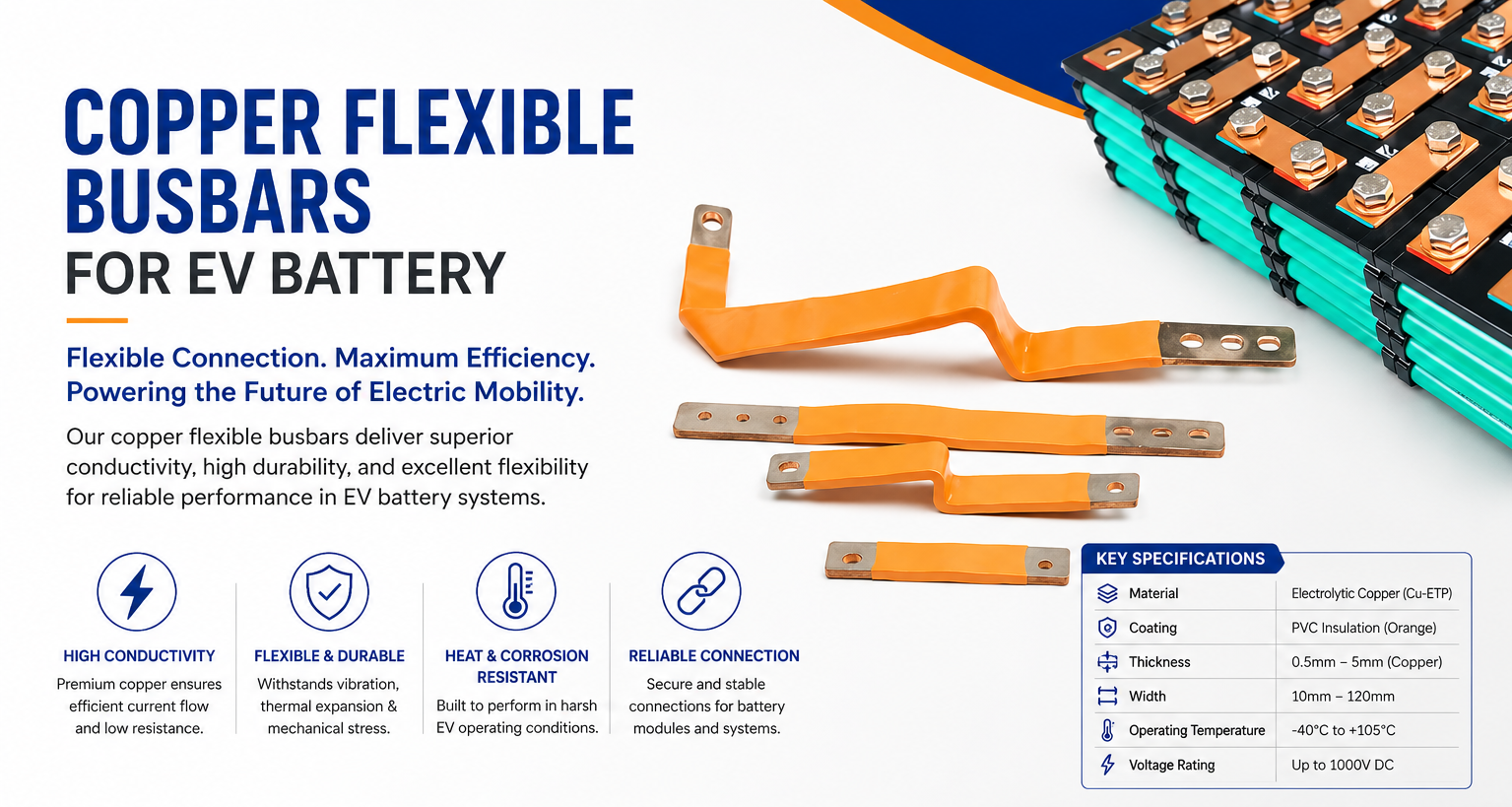
The increasing size of the battery and power-electronics assemblies in an EV demands electrical connections to draw large amounts of current, yet still be compact in dimension. Flexible busbars also have the advantage of allowing for movement, vibration, thermal expansion and installation constraints unlike rigid copper busbars.
Flexible copper busbars can be produced in various designs such as braided copper busbar, laminated flexible copper busbar, multi-layer copper connection and customized flexible copper assembly.
Why Are Flexible Busbars Important for EVs?
There are many electrical components in a compact space of the battery system for EVs.
Battery packs can contain:
The components need to be electrically connected, whilst satisfying mechanical, thermal and space requirements.
A flexible copper busbar can offer an effective current pathway and offer flexibility for routing connections.
| Specification | Details |
|---|---|
| Material | High-Conductivity Copper |
| Copper Grade | ETP / EC Grade |
| Thickness | 0.2–10 mm |
| Width | 10–200 mm |
| Length | Customizable |
Benefits of Copper Flexible Busbars for EV Battery Systems
Excellent Electrical Conductivity:
Copper has excellent electrical conductivity, suitable for high-current power connections.
Proper electrical connections play a crucial role in EV battery systems, helping to manage the power flow between battery modules and other components.
The cross section should be chosen based on the current, temperature, the conditions of installation and the general design of the electrical system.
Compact Design:
Flexible busbars can be formed to conform to battery components and other equipment.
This can be useful to maximize space within an electrical enclosure or battery pack.
Flexible constructions can provide more freedom of routing and positioning than some rigid busbar constructions.
High Flexibility:
Vibrations and mechanical movements are possible at EV components during vehicle operation.
Flexible Copper Busbars are able to bridge some movements and tolerances and still maintain an electrical path.
Reduced Mechanical Stress:
A inflexible busbar can impart mechanical forces directly to the terminals that are connected.
Stress due to vibration, movement and thermal expansion can be reduced by using a flexible busbar to provide mechanical compliance between connection points.
Applications of Flexible Copper Busbars in EV Battery Systems
1) Battery Module Connections:
Copper flexible busbars for EV battery systems offer a solution to connect battery modules and other high current applications that require flexibility, vibration resistance, and space-efficient routing. These copper flexible busbars for EV use ensure reliable electrical behavior, while providing flexibility, thermal expansion and small installation space in battery packs.
2)This power distribution consists of a battery pack:
Copper flexible busbars can be used to make efficient electrical connections between battery sections and power distribution components in EV battery packs. The flexible structure permits designers to configure space optimization and also to ensure the smooth flow of current between the various sections of the battery system.
3) BMS Connections:
Copper flexible busbars for EV applications can be combined with battery management systems (BMS) for the functions of sensing, monitoring and control, depending on system design. These flexible connections can provide signal stability and electrical reliability in small and vibration prone applications.
4) Inverter Connections:
Copper flexible busbars can be used for inverter connections and other high current assemblies where mechanical flexibility is required, especially for EV power electronics. They help to maintain stable electrical performance and minimize the vibration and thermal movement stress on terminals.
Frequently Asked Questions
They can be used for battery module connections, power distribution, inverter and DC-link connections, and other high-current electrical connections where flexibility and compact routing are required.
Copper offers excellent electrical conductivity and can be manufactured into flexible, stranded, braided, or laminated structures.