

Sapphire Copper braided jumpers for transformers allow the components to vibrate, expand thermally and move mechanically while offering a flexible electrical connection between them. The components of transformers can undergo movement during normal operation and the transformer is subjected to electrical and thermal loads.
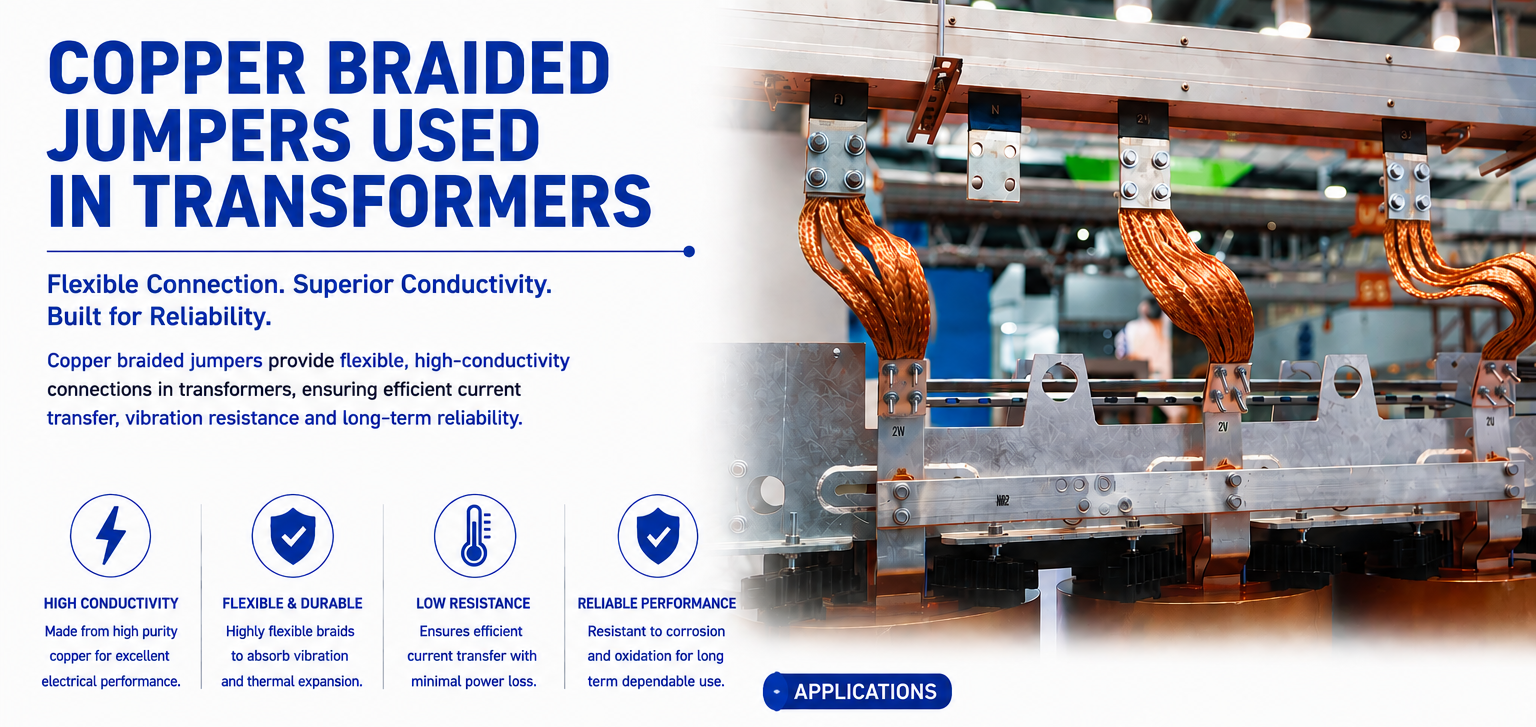
Braided jumpers are made from several strands of fine copper, as opposed to a rigid copper connection. This type of construction is very conductive and will allow for flexibility in connection.
Depending on the design of a transformer, copper braided jumpers can be used for flexible electrical connections, grounding and bonding, connecting transformer parts, as well as connecting to a busbar or another electrical device.
Why Are Copper Braided Jumpers Used in Transformers?
The vibration, temperature variation, thermal expansion and mechanical movement are all possible in the transformer during operation.
These forces can be transferred directly to the terminals and connected components through a rigid electrical connection.
Such movement can be accommodated in a flexible braided jumper that provides for electrical continuity.
| Specification | Details |
|---|---|
| Material | High-Conductivity Copper |
| Copper Grade | ETP / EC Grade |
| Wire Diameter | 0.10–0.30 mm |
| Width | 10–200 mm |
| Length | Customizable |
Copper braided jumpers are used for the following reasons:
Major Benefits of Copper Braided Jumpers for Transformers
Excellent Electrical Conductivity:
Copper is used in electrical conductors, due to its high conductivity.Copper braided jumpers are used to create a pathway that is conductive and flexible.
The area of cross section of the required braid should be determined based on the electrical duty, current, temperature and applicable design requirements.
High Flexibility:
One of the benefits of braided copper jumpers is that they are extremely flexible.
The braid is made up of many separate strands of copper which enable the conductor to flex and bend with greater ease than a solid copper bar.
This is helpful when there is vibration or temperature change-induced movement of components in transformer assemblies.
Vibration Resistance:
Mechanical vibration can be generated during the normal operation of transformers.
Mechanical forces could be applied to these rigid electrical connections due to this vibration.
The flexible copper braided jumper can move, and help to minimize mechanical stresses at the connection points.
Accommodates Thermal Expansion:
During operation components of transformers can be heated.
Materials expand and contract when the temperature changes. A flexible jumper that is braided can allow some relative motion between the connected components.
This can help alleviate stress at terminals and electrical connection locations.
Common Uses of Copper Braided Jumpers in Transformers
Transformer Grounding:
Grounding connections are an important part of transformer installations.
The copper braided jumpers can be used for flexible bonding and grounding connections between the appropriate conductive components.
Transformer Enclosure Bonding:
Conductive elements such as metallic enclosures, covers, access panels, and others can be part of a Transformer.
When components are designed to move or may be opened during maintenance, a flexible copper braid can be employed to keep electrical continuity between these components.
Flexible Electrical Connections:
For some transformer designs, flexibility of electrical connections between the components is required.
Copper braided jumpers might offer the needed flexibility while still ensuring a very good conductive path.
Connections to Busbars:
Flexible copper jumpers can be used to electrically connect transformer components or terminals to busbars or electrical equipment in appropriate transformer assemblies.
Size of the jumper must be appropriate for the electrical and mechanical needs.
Connections in Distribution Equipment:
Transformers are frequently combined with switchgears, Power Distribution Panels and other power equipment.
Wider spacing between components and mechanical movements can be accommodated with flexible copper connections.