

Aluminium busbars alternative to copper is an increasingly important consideration in electrical power distribution. Busbars are made of aluminium and copper – both have their electrical, thermal, mechanical and economic benefits.
Copper also possesses good electrical conductivity, so that smaller busbar cross sections can be used for a given electrical performance. But aluminium is much lighter and may also provide cost and weight savings, especially in systems with a large number of electrical connections.
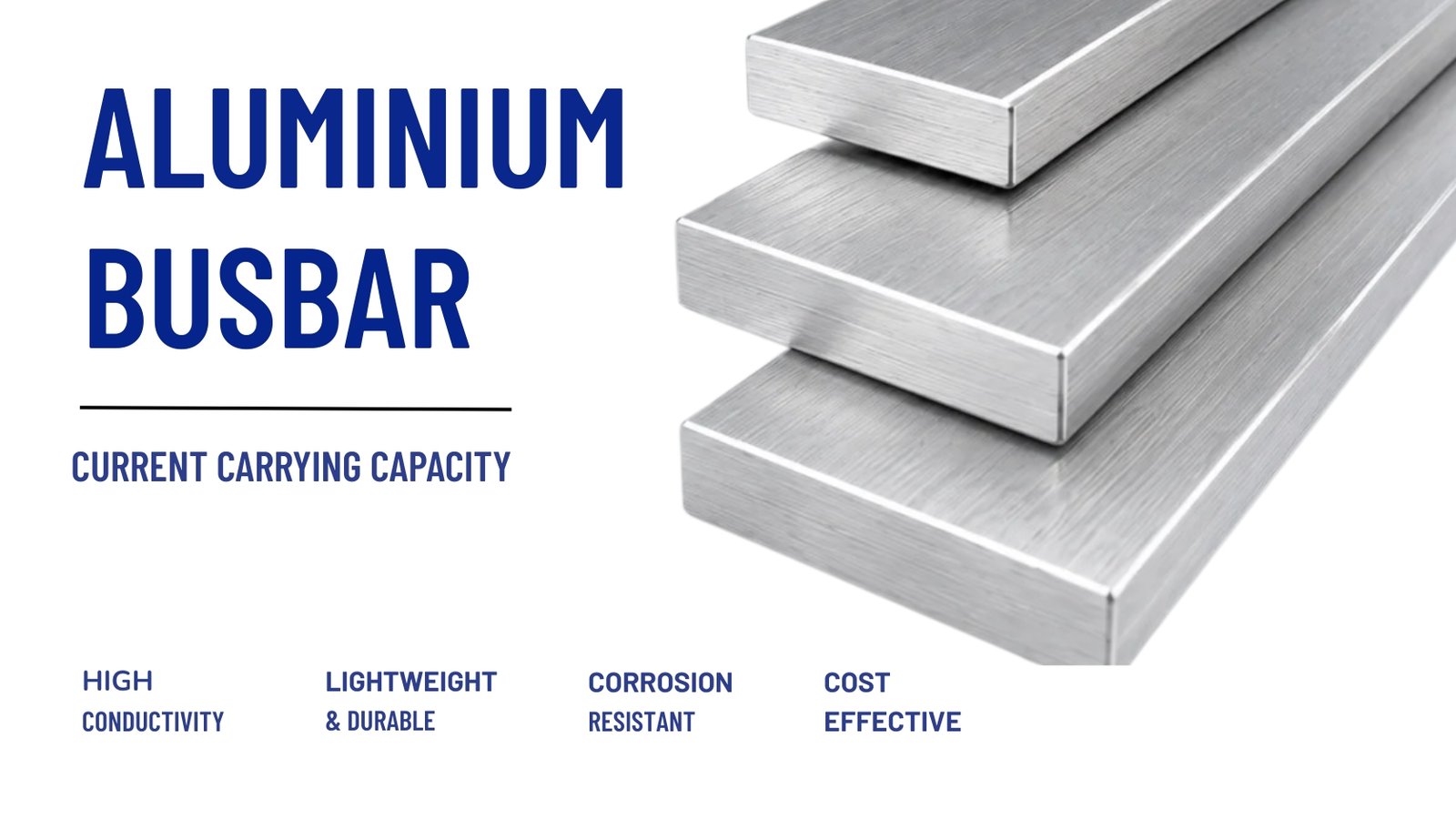
So, are aluminium busbars a good option to copper busbars? Yes, in many applications. But, aluminium is not a direct 1-to-1 replacement for copper. When changing materials, the dimensions, connections, temperature rise, installation conditions, and standards of the busbar must be taken into account.
Why Consider Aluminium as an Alternative to Copper
Lower Weight
Low density is one of the best attributes of aluminium.
The densities of aluminium and copper are about 2.7 g/cm³ and 8.96 g/cm³ respectively.
This implies that the density of aluminium is approximately one third that of copper.
Aluminium busbar can offer considerable weight savings even though it has a lower conductivity rating than other materials, but requires a larger cross section.
Lower Material Cost:
Generally aluminium is cheaper than copper by the weight.
Where large busbar systems are concerned, replacing the copper with the appropriate size aluminium can save material costs.
In addition to the above, the total installed cost should include:
Good Electrical Performance:
Aluminium is less conductive than copper, but is still a viable conductor for many high current applications.
At approximately room temperature:
Copper conductivity: ~58 MS/m
Aluminium conductivity: ~35 MS/m
Under standard reference conditions, this translates to aluminium having about 60% of the conductivity of copper by volume.
As a compromise, an aluminium busbar will have a higher cross sectional area.
Suitable for High-Current Applications:
When correctly designed, aluminium busbars can conduct large currents.
They can be used in suitable:
The rating for the present condition shall be determined by proper calculation, testing or standards.
| Feature | Aluminium Busbar | Copper Busbar |
|---|---|---|
| Electrical conductivity | Lower | Higher |
| Weight | Much lower | Higher |
| Required cross-section | Generally larger | Generally smaller |
| Material cost | Usually lower by weight | Usually higher |
| Current carrying capability | Excellent when properly sized | Excellent |
| Thermal conductivity | Lower | Higher |
Is Aluminium a Good Alternative to Copper Busbars?
Yes, but it is very possible that aluminium can be a very good alternative to copper busbars, provided the system is designed specifically for aluminium.
It is especially appealing for use in large power-distribution systems, switchboards, busducts, busways and industrial installations where low weight and material economics can offer significant advantage.
The final selection should not be made based upon the cost of the material or only its conductivity, but upon the total design of the electrical and mechanical aspects of the system.
Frequently Asked Questions
Yes. Properly sized aluminium busbars can carry high currents and are widely used in large power-distribution systems.