

Conductivity of aluminium busbar is one of the important factors while selecting between aluminium and copper for electrical power distribution. Electrical busbars are used in a wide variety of applications, two of which are most commonly used materials such as aluminium and copper, and they have varying electrical, thermal, mechanical and weight properties.
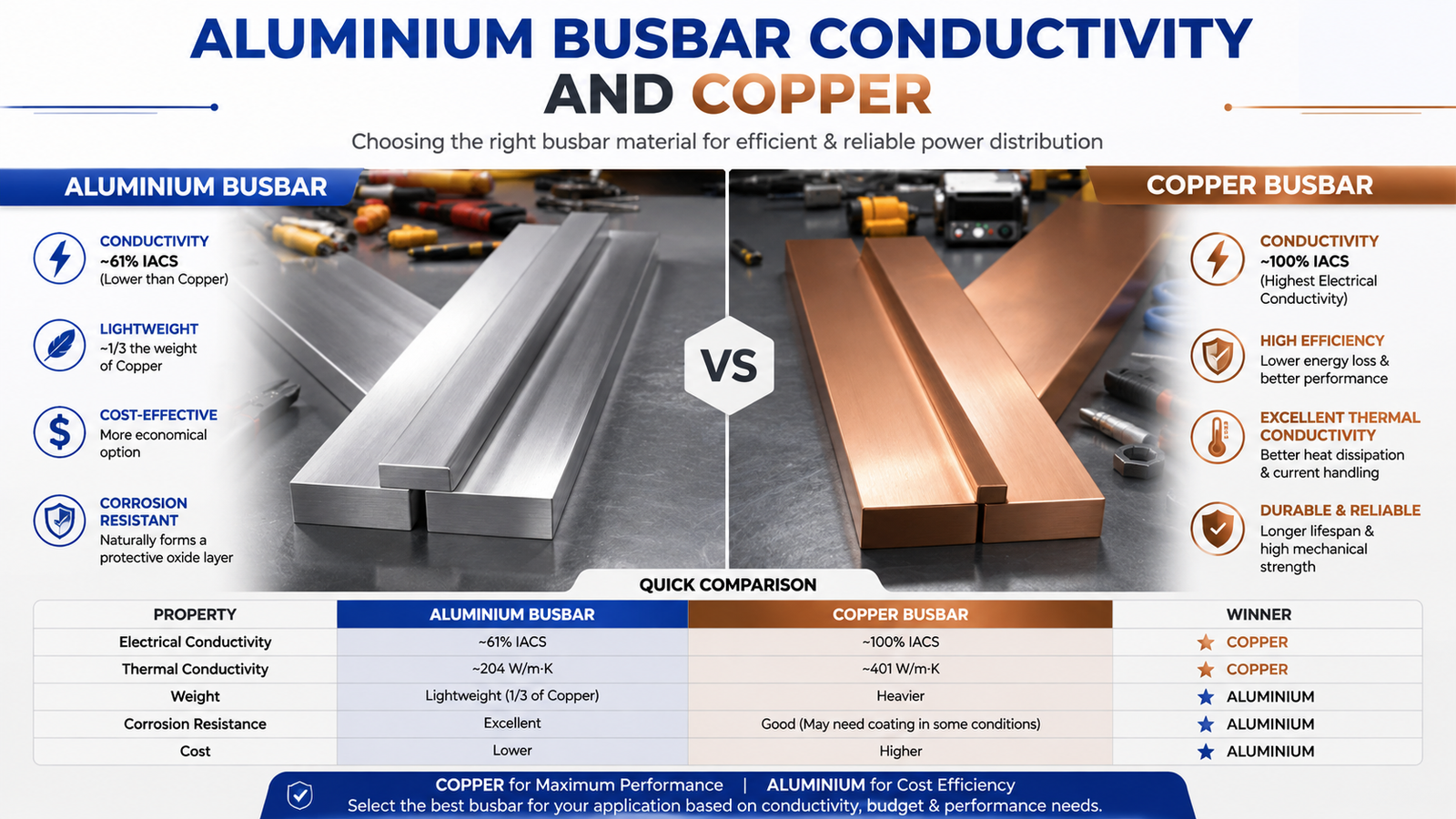
Copper, on average, is a more conductive material than aluminium. That is, in general, a copper busbar may be able to pass as much current as one of a smaller cross section.
However, aluminium busbar conductivity is still sufficient for many electrical power-distribution applications. Aluminium is much lighter than copper and has certain benefits in large electrical installations where weight, material used and overall project costs are factors.
Aluminium or copper, then, is not just a matter of the conductivity. When choosing the right material for the busbar, take into account the capacity, the size of the busbar, the temperature rise, the weight, the design of the busbar, the space available, the environmental conditions and the requirements of the installation.
Aluminium Busbar Conductivity and Current Rating
Many people think that a material’s conductivity is the only factor that affects its current rating.
In practice the capacity of busbars becomes dependent on a number of factors such as:
Conductivity can therefore not be used to make a true comparison of two busbars of different materials.
Appropriate size aluminium busbar can be designed for substantial current.
| Property | Copper | Aluminium |
|---|---|---|
| Electrical conductivity | ~58 MS/m | ~35 MS/m |
| Relative conductivity | ~100% | ~61% |
| Electrical resistivity | ~1.72 µΩ·cm | ~2.82 µΩ·cm |
| Density | ~8.96 g/cm³ | ~2.70 g/cm³ |
| Weight | Higher | Much lower |
Advantages of Aluminium Busbars
1. Lightweight:
The light weight of aluminium makes it very suitable to use in large busbar systems.
2. Good Electrical Performance:
Properly sized aluminium conducts large electrical currents, although less so than copper.
3. Lower Material Weight:
Weight of conductors can be reduced for large installations.
4. Cost Efficiency:
The total installed cost of the aluminium is usually lower than the total installed cost of the copper, but it depends on the full design.
Each of the above provisions apply equally to Large Distribution Systems.
Uses for aluminium include switchboards, industrial distribution and busways.
Aluminium Busbar Conductivity in Electrical Panels
Aluminium busbars can be used in:
When selecting aluminium for an electrical panel, the designer needs to account for its lower conductivity by appropriately sizing the conductor.
Connection design is also especially important because aluminium forms an electrically resistive oxide layer on its surface.