

Modern electrical panels must accommodate more electrical loads in a smaller size enclosure. This has made the problem of safe, compact and reliable electrical connections more and more significant.
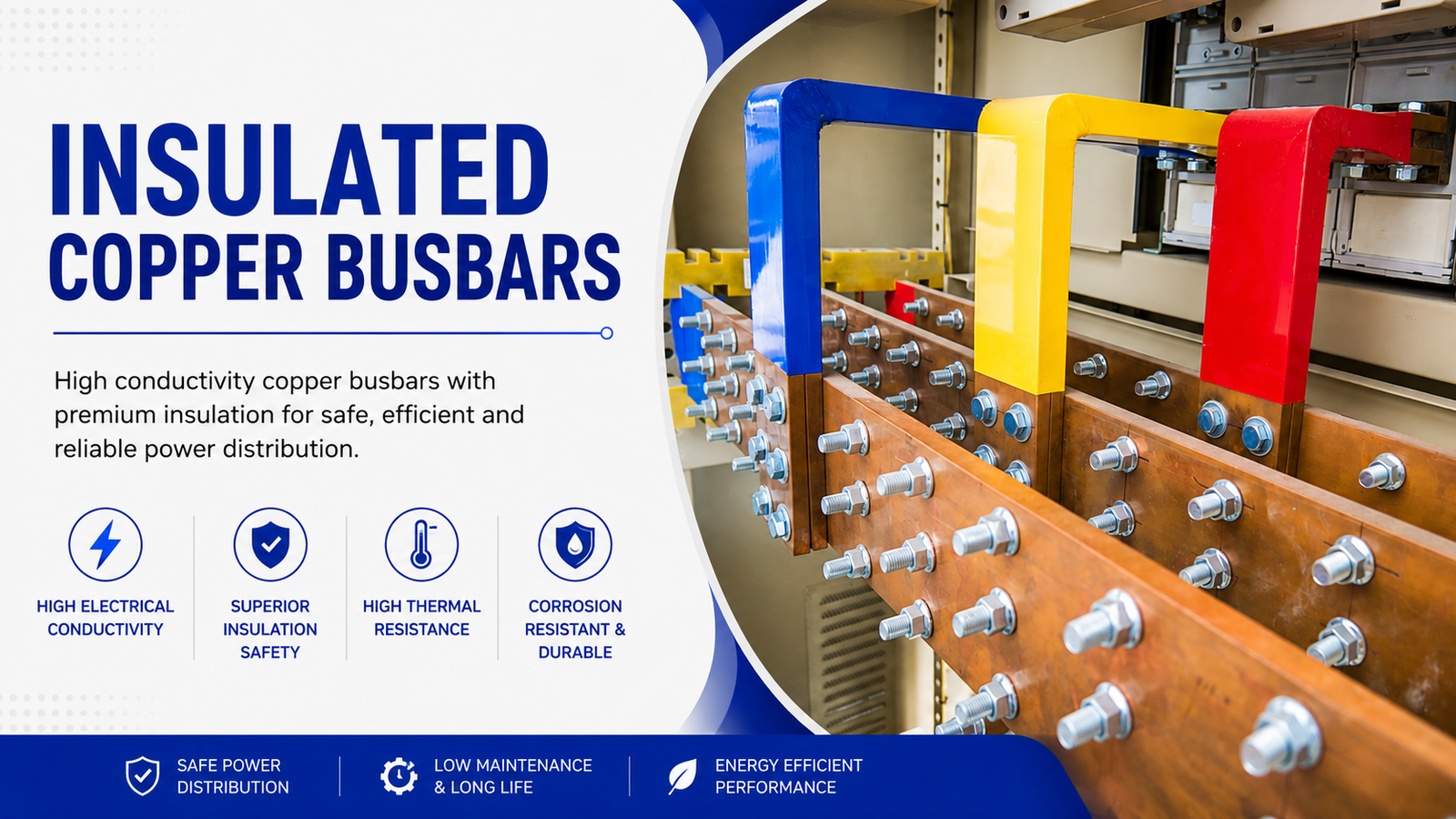
The solution is offered by insulated copper busbars, which are a combination of excellent electrical conductivity of copper and an insulating protective layer. The insulation is used to isolate energized conductors from surrounding conductive items, and the copper is for conducting electric current.
Insulated copper busbars can offer a number of practical advantages, including for distribution boards and switchgear, UPS systems, battery storage, solar inverters and power distribution equipment.
| Feature | Insulated Copper Busbars | Bare Copper Busbars |
|---|---|---|
| Copper conductivity | Excellent | Excellent |
| Insulation | Yes | No |
| Accidental-contact protection | Better | Requires other protection |
| Short-circuit protection from accidental contact | Improved | Requires appropriate spacing/barriers |
| Compact installation | Excellent | Good with proper clearances |
| Environmental protection | Can be improved | More exposed |
What Are Insulated Copper Busbars
An insulated copper busbar is a copper conductor that is insulated by a non-conductive material.
Electrical current flows in the copper core and is electrically separated and protected by the insulating material.
Depending on the application, insulated copper busbars can be:
The insulation can be made using materials such as PVC, polyolefin, polyester, epoxy, heat-shrink materials, or other application-specific insulating systems.
Insulation material should be selected according to the following factors: operating voltage, operating temperature, flexibility, environment and standards.
Improved Electrical Safety:
The one of the most important advantage of insulated copper busbars is the provision of extra electrical barrier around the conductive copper.
The insulation can help reduce the risk of accidental contact with energized conductors during appropriate installation and maintenance conditions.
This can be helpful when dealing with panels that have several conductors and components running close together.
Insulation should be taken into account in the design of safety, however, and not as a substitute for required protection or electrical clearances.
Lower risk of short circuiting:
If an accidental contact occurs between two conductors, or an accidental contact with a ground, a phase-to-phase fault or a phase-to-ground fault can be possible, if the conductors are located too close to each other.
Insulated copper busbars offer an extra protective barrier with the insulation around them.
This can help minimise the risk of inadvertent electrical contact between:
Better Use of Limited Panel Space:
Typical electrical panels have a lot of components in a small enclosure.
Designers can use insulated copper busbars to help manage energised conductors in these limited space requirements.
They can be routed around:
Excellent Electrical Conductivity:
Busbars are made from copper due to its good electrical conductivity.
Insulated copper busbars have a copper core that offers a low-resistance path to carry current.
Electrical performance is influenced by a variety of factors:
Frequently Asked Questions
They are used in electrical panels, switchgear, switchboards, battery systems, EV equipment, solar inverters, UPS systems, energy storage systems, and industrial power equipment.