

Yes, copper flexible jumpers can be used for grounding and bonding if correctly designed, sized, terminated and installed for the application.
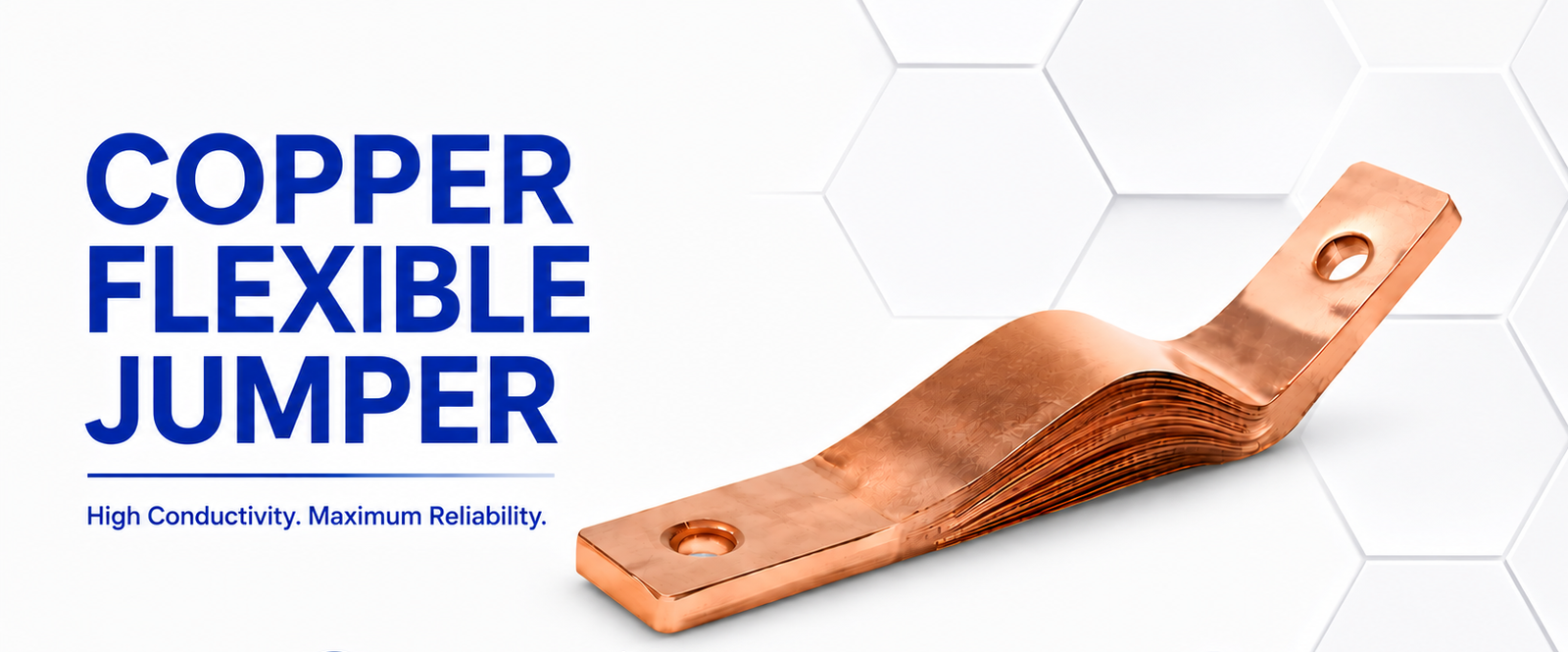
Grounding Jumper: A piece of electrically conductive material that connects equipment, enclosures, panels or other conductive components to ground. Vibration, movement, door operation, thermal expansion and small alignment changes can be accommodated without the use of a rigid conductor, as the flexible construction allows for the connection.
Copper flexible jumpers for grounding are commonly employed in electrical panels, switchgear, transformers, generators, industrial machinery, battery systems and other electrical equipment, due to the material’s excellent electrical conductivity.
Why are copper flexible jumper used for grounding
Mechanical movement of grounding connections may be required.
Such as an electrical-panel door that opens and closes many times. A fixed ground conductor may be hard to maneuver or bend at the ground connection site.
A flexible copper grounding jumper will move with the door keeping continuous electrical connection.
Likewise, flexible bonding connection might be suitable for the equipment subject to vibration or thermal movement.
| Feature | Copper Flexible Jumper | Flexible Grounding Cable |
|---|---|---|
| Construction | Braided/laminated copper or fine strands | Insulated or bare stranded conductor |
| Flexibility | High | High |
| Typical use | Short bonding connections | General grounding runs |
| Compact installations | Excellent | Good |
| Panel-door bonding | Excellent | Suitable |
| High-current fault path | Application dependent | Application dependent |
Copper Flexible Jumpers vs Copper Flexible Busbars for Grounding
For some grounding and bonding situations, a copper flexible busbar can be used.
The terms can vary depending on the product’s usage and design.
A flexible jumper is typically a point-to-point connection, and a a busbar, typically used for powering or a common path for conducting electricity.
Both can work when properly designed for the application, for grounding.
Where Are Copper Flexible Grounding Jumpers Used
Common applications include:
Benefits of Copper Flexible Jumpers for Grounding
1. Maintains Electrical Continuity:
A properly installed jumper conducts a current path between the connected metal parts.
2.Accommodates Movement:
Flexible construction enables the jumper to move doors, covers, equipment or components.
3.Handles Vibration:
It’s capable of absorbing some vibration without being attached firmly.
4.Reduces Mechanical Stress:
The jumper may help to minimize the forces that are transferred to grounding terminals and connection points.
Frequently Asked Questions
Tinned copper can be advantageous in humid or corrosive environments because the tin coating provides additional surface protection. Bare copper can be suitable in protected environments.