

Battery connections using copper flexible jumpers offer a reliable, flexible electrical connection between batteries, terminals, busbars, battery banks and other electrical equipment. Flexibility is important in the design of electrical connections because battery systems may vibrate, move, be subjected to temperature changes, and be periodically serviced.
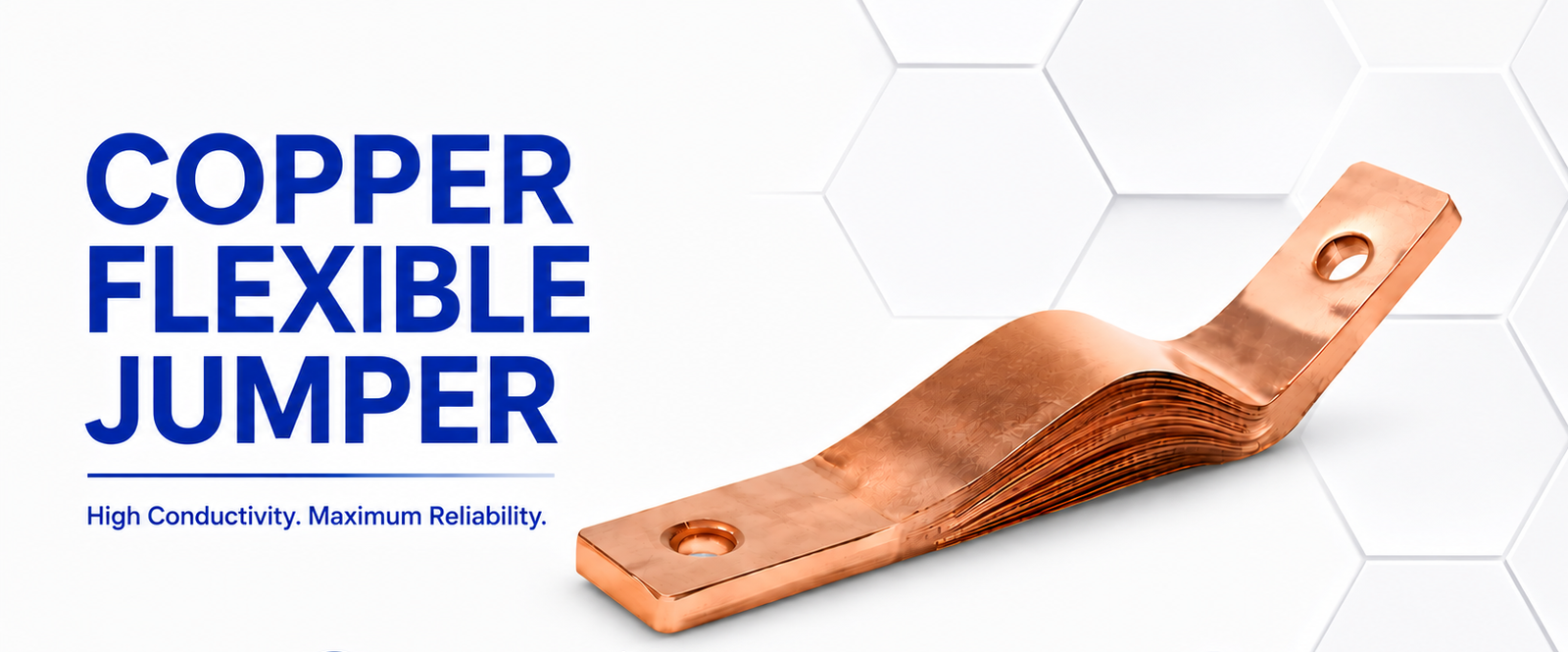
Flexible jumpers are constructed of a number of thin copper strands or braided copper strands, as opposed to rigid conductors. This construction enables the jumper to be able to bend and to move along with a very good electrical conductivity.
They are typically employed in battery banks, UPS systems, energy storage systems, telecommunications, industrial battery systems, automotive equipment, renewable-energy systems, and backup power installations.
What Is a Copper Flexible Battery Jumper?
A flexible electrical conductor used to make electrical connections between two battery terminals or other electrical connection points is known as a copper flexible battery jumper.
It can be made of a fine-stranded copper or woven copper braid and can be available with or without terminal or lugs at the ends.
Depending on the application, copper flexible battery jumpers can be available in:
The jumper’s size and construction should be determined by the electrical and mechanical requirements of the battery system.
| Specification | Copper Flexible Jumpers / Flexible Busbars |
|---|---|
| Material | High-Conductivity Copper |
| Copper Grade | ETP / EC Grade |
| Length | As per requirement |
| Width | 10–200 mm (customizable) |
| Thickness | 0.2–10 mm (customizable) |
| Application | Switchgear, Transformers, Panels, Batteries & Power Systems |
Why Are Flexible Jumpers Used for Battery Connections?
Many battery systems must be connected in such a way that the connection can withstand a relatively large current and at the same time be able to move.
Batteries can vibrate, move, expand, and be serviced causing stress on the battery terminals when connected rigidly.
A mechanical compliant and electrically continuous solution is possible by using a flexible copper jumper.
The primary advantages of battery jumpers that are flexible are:
Benefits of Copper Flexible Jumpers for Batteries
Excellent Electrical Conductivity:
Copper is extensively used for electrical connections owing to its good conductivity.
The proper size copper jumper may afford an efficient conductive path between the battery terminals and other electrical equipment parts.
In battery applications, it’s especially critical to get the right conductor size, as inadequate sizing can result in heat and voltage drop with high currents.
High Flexibility:
A battery bank may consist of several batteries that are packed closely together.
The flexible copper jumper does not need to be aligned with the metal terminals, as solid conductors would need to be.
This simplifies the installation process, especially in battery packages with reduced size.
Reduces Mechanical Stress:
The battery terminals might have a tendency to be sensitive to mechanical loads.
A flexible jumper can lower the transfer of the movement and vibration to the battery terminals as compared to a rigid conductor.
This is particularly helpful in mobile equipment, vehicles, industrial machines and vibration subjected installations.
Vibration Resistance:
Vibration can be experienced continuously in battery systems installed in vehicles or industrial equipment.
This can be achieved with a braided or fine-stranded copper jumper which will allow for the movement yet keep the electrical connection intact.
Common Uses of Copper Flexible Jumpers for Battery Connections
Battery Banks:
Single batteries may be joined together by copper flexible jumpers in a battery bank.
Can be used in series or parallel circuit, depending on system design.
UPS Systems:
The UPS (uninterruptible power supply system) provides power protection by means of a battery bank.
Copper jumpers that are flexible will be used to make connections between batteries in the bank and to provide battery assemblies with associated equipment.
Energy Storage Systems:
Reliable electrical connections between cells, modules, busbars and other components are essential for battery energy storage systems.
Copper flexible connections can allow for movement and ease installation when necessary.
Telecommunications Backup Systems:
Battery backups are often used in telecommunication facilities.
Copper jumpers can be used to connect batteries to power equipment and can be flexible.
Automotive and Mobile Equipment:
When mobile machinery or vehicles are vibrating and moving.
These conditions can be better met by flexible battery jumpers than by many rigid ones.
Industrial Battery Systems:
Flexible copper jumpers are suitable for use in industrial battery systems that require flexibility, such as battery backup power, control systems and other applications.